How Custom Payment Workflows Improve Cash Flow

How Custom Payment Workflows Improve Cash Flow
Late payments are one of the biggest challenges freelancers and small businesses face. Nearly 85% of freelancers encounter delayed invoices, and 21% report frequent non-payments, losing an average of $6,000. These issues disrupt budgets, delay essential expenses, and create financial stress.
Custom payment workflows solve this by securing payment methods upfront, automating invoicing, and setting clear terms. Here's how they help:
- Upfront Payment Security: Collect deposits or payment details before starting work to ensure commitment.
- Clear Agreements: Use milestone-based terms (e.g., 50% upfront, 25% mid-project) to avoid disputes.
- Automation: Automate invoicing, reminders, and payment collection to save time and reduce errors.
This approach simplifies payment processes, improves cash flow consistency, and reduces the risk of disputes, helping you focus on growing your business instead of chasing payments.
I Built 5 AI Agents That Make Me $5000 Every Month (You Can Copy Them)
sbb-itb-66f4c95
Cash Flow Problems Freelancers and Small Businesses Face
Payment problems that disrupt cash flow are rarely random; they often follow a predictable pattern. By understanding these recurring challenges, freelancers and small businesses can better prepare to address them. Here are some of the most common cash flow obstacles they encounter.
Late Payments and Lack of Payment Security
Did you know that nearly half of all B2B invoices in the U.S. are paid late? On average, small business invoices are settled eight days after their due date. These delays usually happen because invoices get lost in chaotic accounts payable systems or stuck in lengthy approval chains. Sometimes, clients facing their own financial struggles intentionally hold back payments. Worse, some clients use your work immediately but delay payment to boost their own cash reserves.
When freelancers or businesses begin projects without securing upfront payment details, they’re essentially financing the client’s work. This lack of payment security eliminates any urgency for clients to pay promptly.
"Late payments are one of the most damaging problems facing freelancers, contractors, and small businesses... It's a cash flow crisis that can threaten your ability to pay your own bills."
– InvoiceQuickly
Disputes from Unclear Agreements
Vague contract terms can open the door to payment disputes. For example, phrases like "payment upon completion" can give clients room to delay final acceptance for weeks - or even months. They may claim the work doesn’t meet unclear standards or withhold payment while requesting additional revisions or clarifications. Without clear deadlines, such as "Net 15" or "Net 30", it’s tough to define when a payment is overdue, let alone enforce penalties like late fees.
Additionally, overly simplistic invoice descriptions - like "Design services - $500" - can lead clients to question the scope of the work, requiring you to follow up unnecessarily.
Errors from Manual Invoicing
Manual invoicing is a breeding ground for mistakes, and these errors can delay payments. Over 30% of late payments are caused by issues like incorrect tax rates, missing purchase order numbers, miscalculated totals, or forgotten tax identifiers. Each mistake forces clients to request corrections, dragging out the payment process.
Freelancers spend an average of 20 hours per month on financial management tasks, including creating and reconciling invoices manually. That’s valuable time that could be spent on income-generating work. Interestingly, invoices sent within 24 hours of completing a project are paid an average of 18 days faster than those sent a week later.
"My biggest mistake was not invoicing immediately upon job completion. I used to batch invoices weekly... Now our technicians send invoices from the field using mobile apps - payment requests go out within hours, not days."
– Stephanie Allen, CEO, AirWorks Solutions
On top of invoicing errors, internal approval bottlenecks can further slow the payment process.
Delayed Payment Approvals
Corporate clients often require multiple layers of approval before releasing funds. Even when a project is complete and the invoice is accurate, it might sit on a manager’s desk for days, waiting for sign-offs. Other priorities often take precedence, delaying access to your funds.
These delays can quickly spiral into bigger problems. Once an invoice is more than 90 days overdue, the chances of collecting payment drop to about 50%. What starts as a minor delay can turn into a financial headache, making it harder to cover essential expenses. This is where automated workflows can help, streamlining the approval process and ensuring payments are released on time.
How Custom Payment Workflows Fix These Problems
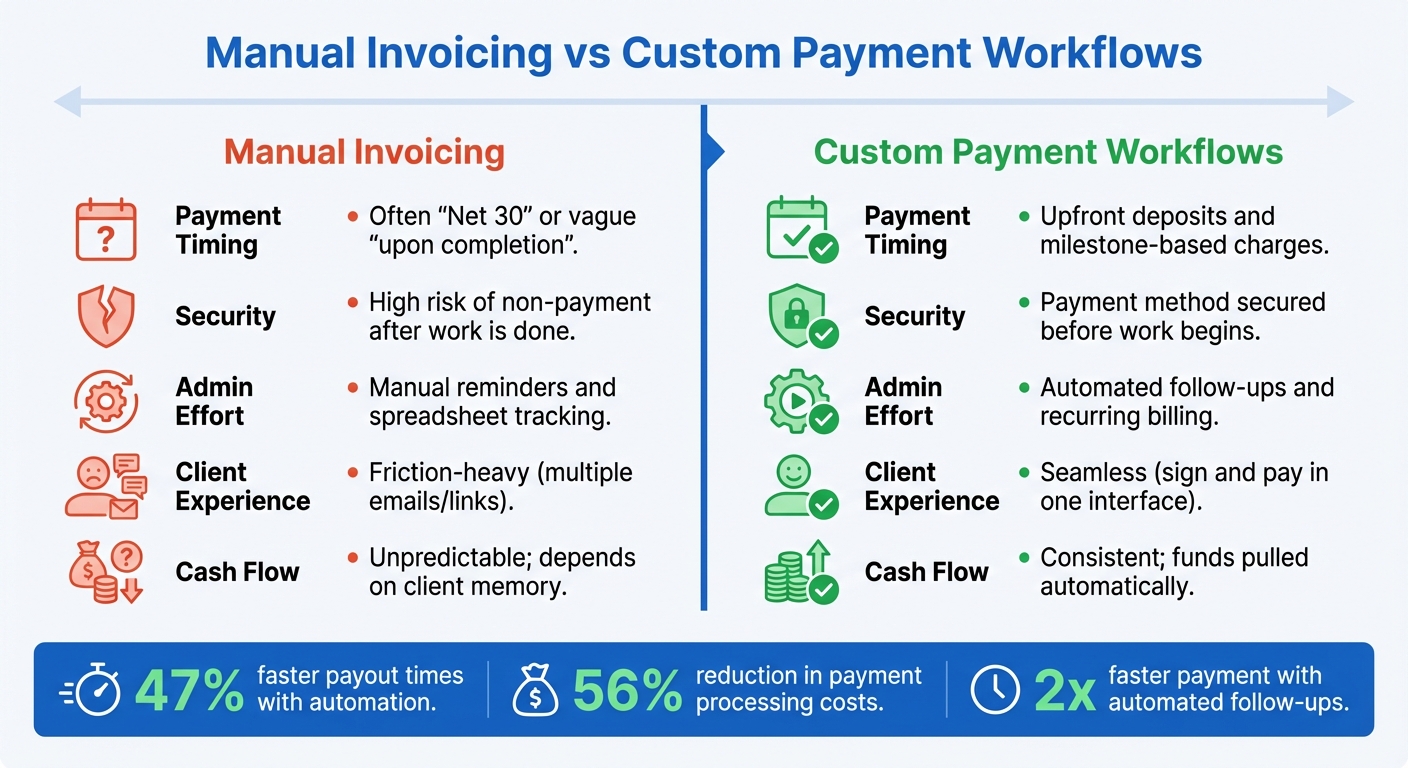
Manual Invoicing vs Custom Payment Workflows Comparison
Custom payment workflows solve cash flow issues by streamlining how payments are collected. Instead of relying on clients to pay after you've already put in the work, these workflows secure payment commitments upfront. This eliminates delays caused by back-and-forth communications and uncertainty.
The concept is straightforward: traditional invoicing waits for payment after the fact, while custom workflows ensure payment methods are secured before any work begins. This shift tackles common freelancer headaches like late payments, disputes, and administrative mistakes.
Collecting Payment Methods Before Starting Work
Getting a client's payment method in advance acts as both a financial safety net and a way to gauge their commitment. For example, requiring a 50% deposit before starting a project ensures the client is serious about moving forward. Modern workflows simplify this process by combining proposals, contracts, and payment collection into a single step. Clients can review terms, sign agreements, and authorize payments all at once. Once their payment information is securely stored, you can automatically charge the remaining balance when milestones are met or the project is completed. For added security, especially with new or high-risk clients, some workflows include escrow services, where a neutral third party holds funds until the work is approved.
"The most effective strategy I've implemented is requiring 50% deposits before any major equipment installation begins... we're never out thousands of dollars waiting for payment."
– Stephanie Allen, CEO, AirWorks Solutions
This approach also helps freelancers move away from risky "Net 30" terms using proven methods to get paid on time, which often force them to finance a client’s project out of their own pocket. Instead, they can adopt due-upon-receipt or milestone-based billing for more predictable cash flow.
Once payment methods are secured, the next step is to establish clear agreements.
Building Clear, Legally Binding Agreements
Custom payment workflows replace vague terms with specific, legally binding agreements. Instead of relying on ambiguous phrases like "payment upon completion", these workflows set clear deadlines such as "Net 15" or "Net 30." Projects are often divided into milestone-based payment triggers, such as 50% upfront, 25% upon mockup approval, and 25% upon final delivery. This structure creates a steady revenue stream and reduces delays in receiving final payments.
"The biggest shift was implementing milestone-based payments tied to specific deliverables... Clients can't move forward without paying for the previous phase, which naturally creates payment urgency without awkward conversations."
– Damon Delcoro, Founder, UltraWeb Marketing
Strong agreements also include enforcement mechanisms, like charging a 1.5% monthly late fee or halting work if payments are overdue by a certain number of days (often 7).
"The key is having clear contract language that allows work stoppage after 7 days past due. When a $6,000 HVAC installation sits incomplete in their home, clients suddenly find ways to pay quickly."
– Stephanie Allen, CEO, AirWorks Solutions
These agreements act as professional tools to set expectations and keep cash flow steady.
After agreements are in place, automation ensures timely payments for completed work.
Automating Payments After Work Completion
Once deposits are collected and terms are clear, automation takes care of the rest. As soon as a project milestone is completed or a billing cycle begins, the system automatically generates an invoice. Adding a "Pay Now" button to invoices allows clients to make payments with a single click.
Automation also helps with follow-ups. Scheduled reminders - such as a gentle nudge 2 days after the due date, a firmer reminder at 9 days, and a final notice at 14 days - can significantly speed up payment times. In fact, invoices with at least one automated follow-up are paid twice as fast as those without.
Here’s how manual invoicing stacks up against custom payment workflows:
| Feature | Manual Invoicing | Custom Payment Workflows |
|---|---|---|
| Payment Timing | Often "Net 30" or vague "upon completion" | Upfront deposits and milestone-based charges |
| Security | High risk of non-payment after work is done | Payment method secured before work begins |
| Admin Effort | Manual reminders and spreadsheet tracking | Automated follow-ups and recurring billing |
| Client Experience | Friction-heavy (multiple emails/links) | Seamless (sign and pay in one interface) |
| Cash Flow | Unpredictable; depends on client memory | Consistent; funds pulled automatically |
The results speak for themselves. Automated bank payments can cut payout times by 47% and reduce payment processing costs by 56%. For freelancers who spend about 20 hours a month managing finances, these savings mean more time for billable work.
"The freelancers who get paid reliably are not more talented or more likable. They just have a system that makes payment the default outcome of approval."
– GetPaidFirst
Setting Up Custom Workflows with Paid on Time
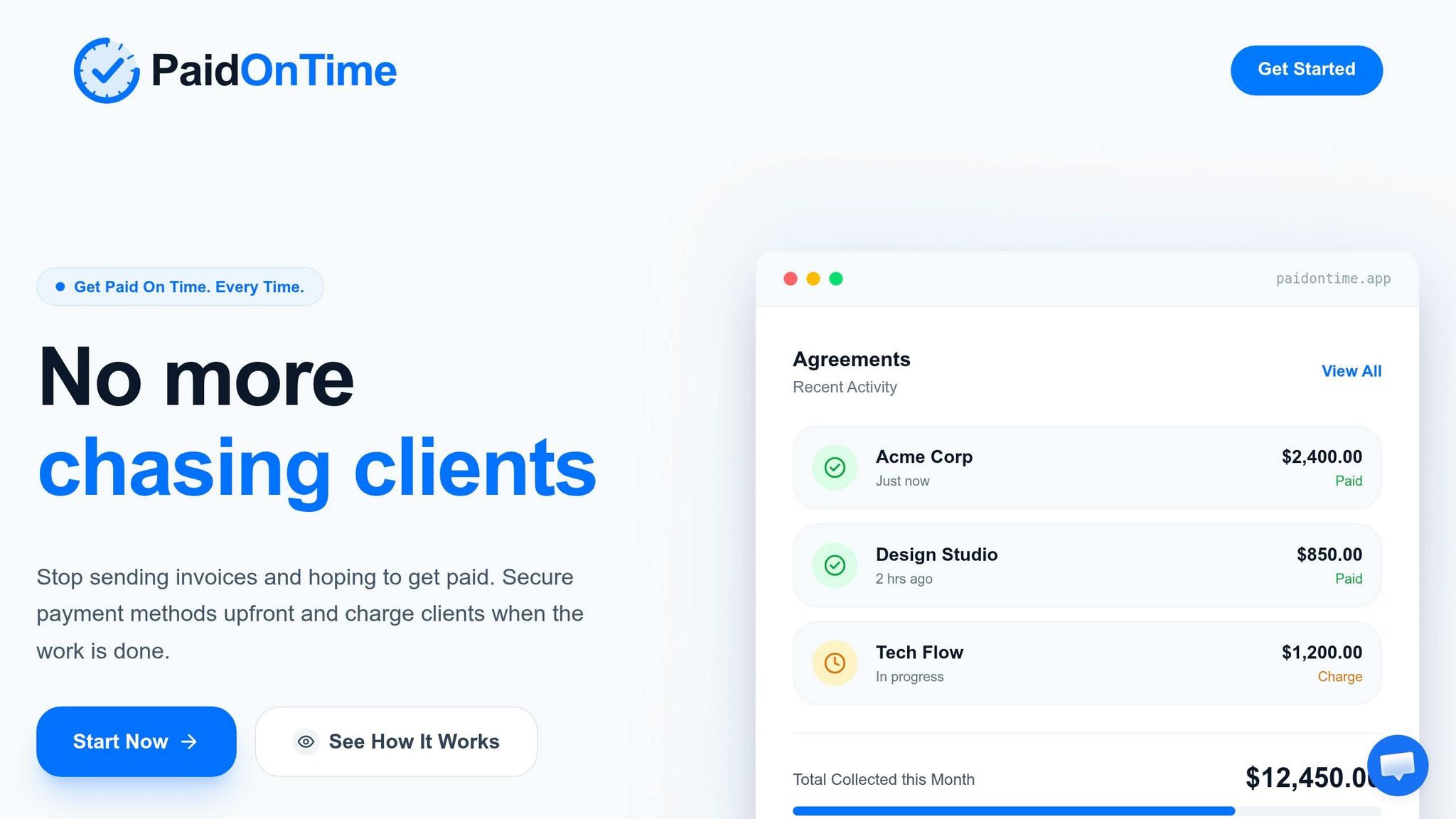
Here’s how you can use Paid on Time to create custom workflows that simplify payment processes and align financial transactions with your project agreements.
Paid on Time combines agreement creation, secure payment collection, and automatic charging into a single, streamlined system. This eliminates the hassle of chasing payments or dealing with unclear commitments. The platform charges a 5% fee only when you get paid - there are no monthly subscription costs.
Step 1: Create Your Agreement
Start by drafting a legally binding agreement that clearly outlines your project terms. For fixed-scope projects under $2,000, request full payment upfront. For larger projects, split payments into milestones - like 30% upfront, 40% at the midpoint, and the remaining 30% upon final delivery. To ensure smooth progress, include terms that require milestone payments before moving to the next phase.
This document combines your proposal, contract terms, and payment authorization into one cohesive agreement. Clients can review and approve everything in a single step, making the process efficient and straightforward.
Once your agreement is ready, the next step is securely collecting payment details.
Step 2: Collect Payment Methods Securely
Paid on Time uses PCI-compliant processors to capture payment details during the agreement-signing process. Clients can authorize their preferred payment method - whether it’s a credit card or ACH bank transfer - right away. This eliminates delays caused by verbal agreements that don’t translate into actual payments.
With payment methods securely stored, you can automatically charge clients as milestones are completed, ensuring only committed clients proceed.
Step 3: Enable Automatic Charges
When a milestone is complete, simply mark it as done to trigger an automatic charge. This pull-based system puts you in control of when funds are collected, removing the need for manual invoicing or follow-ups. For ongoing projects or retainer arrangements, you can schedule regular charges at the start of each billing cycle, eliminating repetitive administrative tasks.
This system transforms your cash flow, giving you predictable revenue and moving your income from uncertainty to stability.
How Custom Payment Workflows Improve Cash Flow
With secure upfront payments and automated charges in place, cash flow can shift from being a constant headache to a more manageable part of your business. This change is especially noticeable in three key areas: consistent revenue, fewer disputes, and quicker access to your money.
Consistent Revenue
When you rely on secure payment methods and clear agreements, your cash flow becomes more predictable. Custom workflows help smooth out revenue fluctuations. For instance, breaking down payments into milestones - like 30% upfront, 40% midway, and 30% upon delivery - ensures a steady stream of income instead of leaving you with unpaid invoices piling up.
This approach has worked for many. Damon Delcoro of UltraWeb Marketing uses milestone payments to stabilize revenue. Similarly, Stephanie Allen, CEO of AirWorks Solutions, requires a 50% deposit before installing major HVAC equipment and offers a 2% discount for payments made within 10 days. Her strategy led to 60% of clients paying early, significantly improving cash flow compared to standard 30-day terms.
Reduced Payment Disputes
Clear agreements go a long way in reducing misunderstandings. When clients approve payment terms, deliverables, and deadlines upfront - and payment methods are secured early - there’s little room for disputes later on.
"Clients can't move forward without paying for the previous phase, which naturally creates payment urgency without awkward conversations." – Damon Delcoro, Founder, UltraWeb Marketing
Invoices that include at least one automated follow-up reminder get paid twice as fast as those without reminders. This not only accelerates payments but also helps set professional boundaries without requiring constant manual follow-ups.
Faster Access to Funds
Automated payment systems bridge the gap between completing work and getting paid. For example, automated bank payment solutions can reduce payout times by 47% and cut the cost of processing payments by 56%. Sean Gallagher, Founder of Gallagher Website Design, implemented a system that securely stored client payment details and auto-charged the remaining balance immediately after project completion. As a result, he eliminated the usual 15–30 day wait for payment.
Quicker access to funds means you can cover essential expenses - like rent, software subscriptions, and supplier payments - on time. Late payments are a common issue, with 85% of freelancers experiencing them at some point. Custom workflows give you more control, turning cash flow into something you actively manage instead of something that controls you.
Conclusion
Custom payment workflows can take the stress out of managing cash flow. By securing payment methods beforehand, setting clear terms, and automating charges once the job is done, you replace the chaos of late payments and disputes with a dependable, repeatable system.
This approach directly tackles the challenges of delayed payments, which can jeopardize your ability to cover essential expenses. A well-thought-out workflow solves these issues at their root by setting professional expectations before any work begins.
"A payment clause is not adversarial; it is a professional project management tool that establishes clear expectations and ensures a smooth, predictable cash flow." – PactlyApp
Automating payments doesn’t complicate things - it simplifies them. Instead of waiting 15–30 days for payments, automated one-click charges ensure you get paid immediately. This gives you control over your cash flow, transforming the way your business operates.
With this streamlined process, not only do you ensure steady cash flow, but you also strengthen your business operations. Platforms like Paid on Time make this strategy easy to implement without requiring costly software or complex setups. With no monthly fees and a 5% transaction fee only when you get paid, it’s a practical solution. The platform handles legal agreements, secures payment methods, and enables one-click charges - turning a complicated payment process into something you control with ease.
FAQs
What’s the best deposit percentage to request?
For fixed-scope projects, starting with a 50% deposit is a common approach. For smaller projects, it might make sense to request 100% upfront, while larger projects often begin with a 25–30% deposit. The percentage can be adjusted depending on the project's size and scope to maintain trust and ensure a steady cash flow for both parties.
How do I set milestones without scaring clients off?
To create effective milestones, it's important to communicate their purpose clearly and in a professional manner. Explain that milestones help maintain a steady cash flow, safeguard the client’s investment, and encourage open communication. Emphasize the advantages of dividing projects into stages, with payments linked to specific deliverables, as a way to benefit both parties. By setting clear expectations - such as timelines, deliverables, and review checkpoints - from the start, you can reassure clients that the process is fair, organized, and transparent.
Can I legally auto-charge clients after they sign?
Yes, businesses can charge clients automatically, but only if clients give clear and explicit authorization for recurring payments. This approach is widely used to simplify payment processes and ensure payments are made on time. It’s crucial to have this authorization properly documented to prevent any potential disputes down the line.