How Subscription Services Improve Cash Flow

How Subscription Services Improve Cash Flow
Freelancers often face unpredictable income and late payments, leading to cash flow problems. A subscription-based model offers a solution by generating steady, recurring revenue. This approach helps cover monthly expenses, reduces financial stress, and allows better planning. Key benefits include:
- Predictable Income: Revenue becomes consistent, reducing reliance on savings or debt.
- Reduced Late Payments: Automated billing tools like Paid on Time ensure timely payments.
- Financial Stability: Subscriptions create a reliable income "floor", making budgeting easier.
- Client Retention: Long-term relationships replace one-off projects.
306: Offering Recurring Subscriptions As A Freelancer | The Holy Grail Of Freelancing
sbb-itb-66f4c95
Common Cash Flow Problems for Freelancers
Freelancers often face a frustrating challenge: their earnings and expenses rarely align. While rent, health insurance, and software subscriptions are due like clockwork each month, client payments tend to arrive inconsistently. This mismatch creates what financial experts call the "timing gap." Essentially, you might be fully booked and profitable on paper, yet still find yourself without the cash needed to pay your bills. The problem worsens when clients delay payments.
Late payments are a major contributor. Recent data shows that 85% of freelancers experience late payments at least occasionally, and 21% face late or non-payment more than half the time.
"Late payments don't just test your patience; they disrupt cash flow and make it harder to plan ahead. Unlike big companies, solo professionals don't have steady cash reserves to fall back on." – Anastasia Ushakova, Solowise Contributor
Another common issue is sequential project stacking, where freelancers only start looking for new work after completing their current project. This approach often leaves them with 2–6 week gaps between gigs, during which income stalls while expenses keep piling up. Many end up dipping into savings or even taking on debt just to cover basic costs during these dry spells.
The emotional impact of these financial ups and downs is profound. Experts describe it as "emotional whiplash." Low-income months can trigger impostor syndrome and desperation, while high-earning months may lead to overconfidence and overspending. This cycle of reactive decision-making makes it difficult to build a financial safety net. Without steady income, freelancers struggle to budget, prepare for taxes, or explore revenue options like subscriptions. The result? A constant need for more dependable income streams. Exploring freelancer tools can help bridge these gaps.
How to Set Up Subscription Services for Better Cash Flow
Find Services That Work as Subscriptions
Turning irregular income into a steady stream starts with identifying your clients' recurring needs. Take a close look at the work you've done over the past 6–12 months. Are there tasks that clients frequently ask for? These might include website maintenance, content updates, performance monitoring, or periodic strategy reviews.
Often, clients still need help after a project wraps up - whether it’s technical support, updating content, or refining strategies. These ongoing needs can be bundled into subscription models like access-based plans (e.g., regular strategy calls or priority support), deliverable-based plans (e.g., monthly blog posts or design updates), or maintenance subscriptions (e.g., regular updates and monitoring). Fun fact: offering maintenance plans at the end of a project can result in conversion rates as high as 70%.
Set Up Pricing and Subscription Tiers
A well-structured pricing model is crucial. Many freelancers find success with a tiered approach, such as "Starter", "Pro", and "Enterprise" options. To set your rates, calculate the average hours you'll spend monthly, factor in your target hourly rate, and add a 10–30% buffer. This ensures your retainer rates are both fair and profitable.
Be specific about what each tier includes - from deliverables to response times and revision limits. This clarity helps prevent scope creep, which can eat into your profits. A simple trick? Highlight your middle tier as the "Most Popular" option. This alone can increase subscriptions for that tier by 10–20%. Sweeten the deal by offering a 15–20% discount for clients who pay annually. It’s a win-win: you get upfront cash, and clients save money.
"The difference between a subscription business that plateaus at $50K ARR and one that scales to $5M isn't the billing software... It's how you monetize." – Dan Layfield, growth expert
Once your pricing structure is ready, streamline your process by automating agreements and payments.
Create Agreements and Automate Payments with Paid on Time
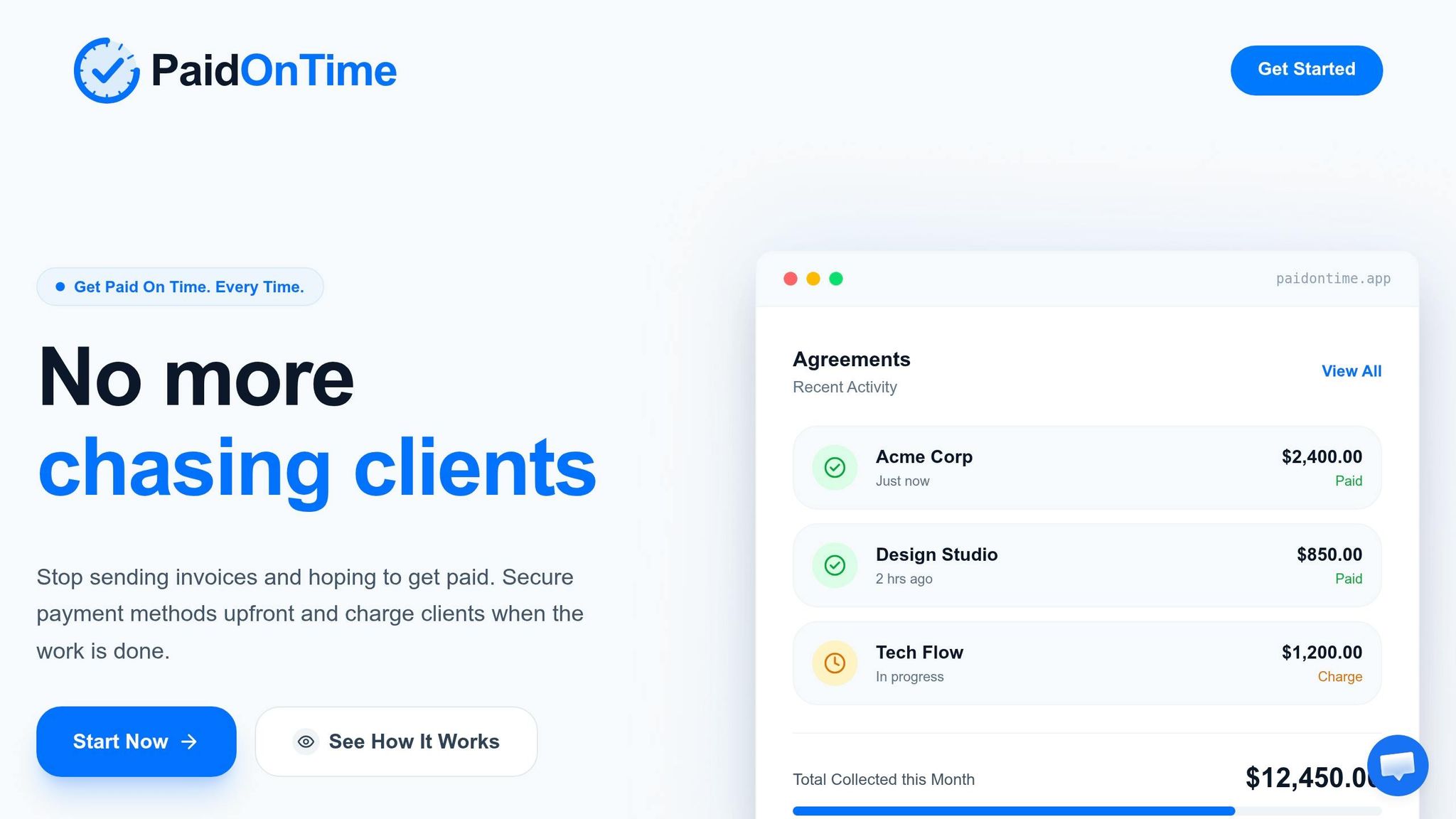
Relying on manual invoicing can lead to the same cash flow headaches you’re trying to avoid. That’s where Paid on Time (https://paidontime.app) comes in. This platform simplifies everything: create legally binding agreements, collect payment methods upfront, and charge clients with a single click once the work is done. No more chasing payments every month.
By securing payment details during onboarding, the platform ensures charges happen automatically on your subscription schedule. This steady flow of revenue, often called "compounding cash flow", builds predictability into your income without the hassle of monthly invoice creation. Plus, with tokenization technology, payment details are stored securely, reducing compliance risks and protecting sensitive data.
When 40–60% of your income becomes recurring through automated systems like this, you’ll notice a big drop in stress. It also gives you the freedom to be more selective about one-off projects. And with Paid on Time’s 5% transaction fee and no monthly subscription costs, you only pay when you get paid. It’s a low-risk way to stabilize your income while saving time and effort. By automating payments, you’re building on the consistency of your subscription model to create a more reliable and stress-free cash flow.
Getting More from Your Subscription Model
Fine-tuning your subscription model can help you secure steady and predictable cash flow.
Offer Annual Billing for Immediate Cash
Once your subscription service is up and running, consider transitioning customers to annual billing. This shift can provide a significant cash flow boost, as you’ll collect a full year’s revenue upfront instead of waiting for 12 separate monthly payments. This influx of capital can help you invest in new equipment, cover slower months, or even reduce reliance on external funding.
Here’s another benefit: annual subscribers are much less likely to cancel than monthly ones. While monthly subscribers tend to cancel at an annual rate of about 40%, annual churn rates typically fall between 10% and 20%. That’s a big difference - annual plans can help you retain customers longer.
To encourage customers to switch, offer a discount for committing to an annual plan. A 15% to 20% discount is common and effective. Discounts under 15% often don’t persuade clients, while going over 30% could unnecessarily cut into your revenue. Be specific about the savings, like saying, "Switching to annual billing saves you $200 per year". The best time to pitch this option? Right after a client achieves a major success or milestone with your service.
Finally, track how your annual plans perform to ensure they’re delivering the results you expect.
Monitor and Improve Performance Metrics
Keeping an eye on performance metrics is key to spotting and fixing issues early. Start with Monthly Recurring Revenue (MRR), which reflects your total predictable income each month. Also, monitor your churn rate - the percentage of subscribers you lose during a given period. If your monthly churn rate exceeds 2%, it’s worth investigating. At 5% monthly churn, you’d need to replace your entire customer base every 20 months.
Interestingly, 20% to 40% of cancellations aren’t intentional - they’re caused by failed payments. You can recover 60% to 80% of these failed charges by setting up automated payment retries at intervals like 3, 7, and 14 days after the failure. Make the process simple for customers by sending clear emails with one-click payment update links.
Another way to reduce cancellations is by offering a "pause" option. Instead of letting customers cancel outright, allow them to pause their subscription for 1–3 months. This strategy can retain 20% to 35% of subscribers who were planning to leave.
Lastly, track your Net Revenue Retention (NRR). If it’s over 100%, it means your existing customers are spending more with you over time, even after accounting for cancellations. This is often seen as the gold standard for a thriving subscription business. By focusing on these strategies, you’ll not only secure immediate cash but also build a more reliable, long-term income stream.
Project-Based Income vs. Subscription Income
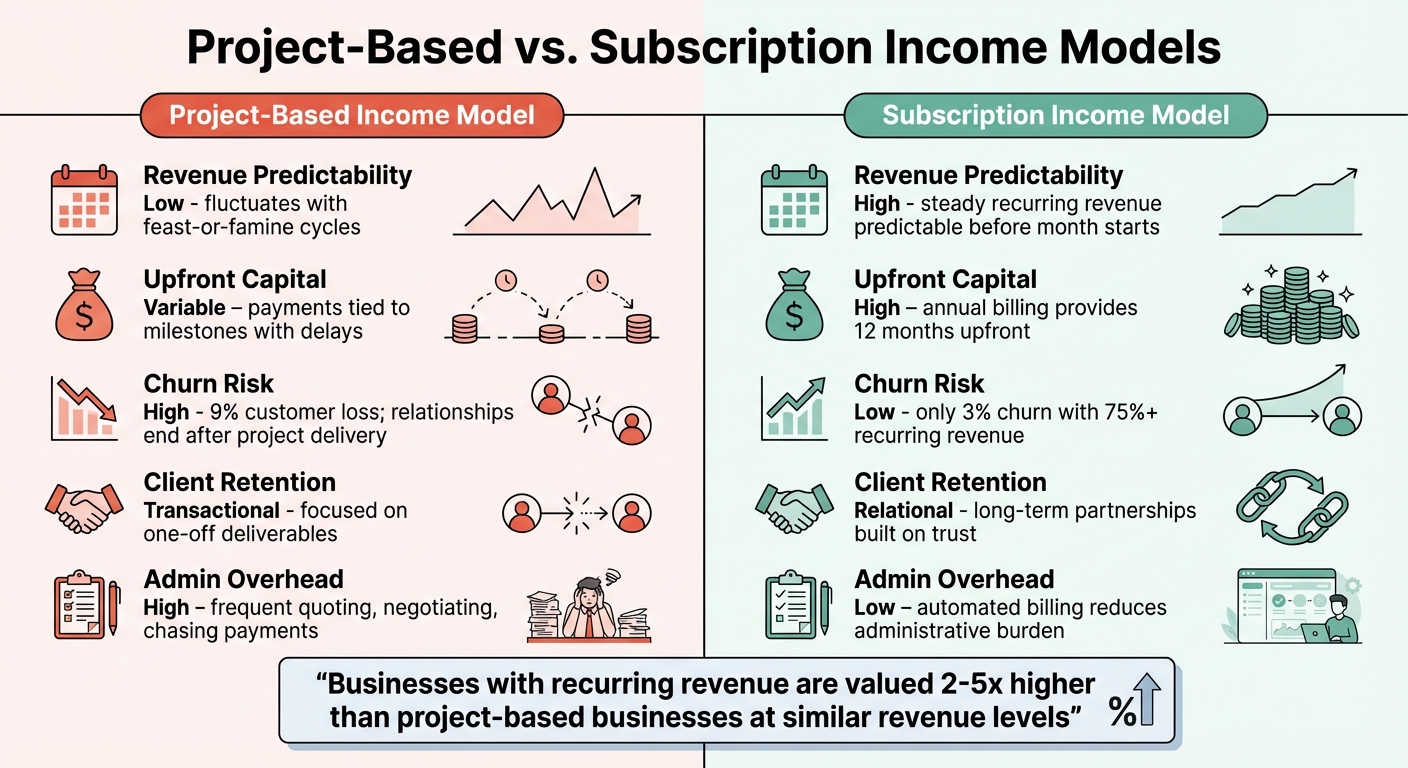
Project-Based vs Subscription Income Models: Key Differences for Freelancers
The way you earn income can shape how you work and plan for the future. Project-based models often lead to a reactive approach, where you're constantly chasing the next gig to start from scratch every month. It’s a cycle of hunting for new clients and closing deals just to keep things afloat. Subscription models, on the other hand, bring a completely different dynamic. With each new client, your revenue base grows, providing a more stable financial foundation. This creates what’s often referred to as a "higher floor" for the next month. When recurring revenue covers your basic expenses, any additional sales become pure growth rather than a necessity for survival.
This kind of stability isn’t just comforting - it opens doors. You can make long-term investments, focus on selective projects, and plan strategically. It’s no surprise that businesses with recurring revenue are valued 2–5 times higher than those relying solely on project-based income, even at similar revenue levels. Retention rates also show a stark difference. Companies without annual contracts or subscriptions typically lose 9% of their customers, while those with at least 75% recurring revenue experience churn rates as low as 3%.
The table below highlights the key differences between these two income models:
Table: Project-Based vs. Subscription Models
| Feature | Project-Based Model | Subscription Model |
|---|---|---|
| Revenue Predictability | Low; income fluctuates with feast-or-famine cycles | High; steady recurring revenue that’s predictable before the month starts |
| Upfront Capital | Variable; payments often tied to milestones, with delays | High; annual billing options can provide upfront payments for 12 months |
| Churn Risk | High; relationships end after project delivery, with no guarantee of repeat work | Low; businesses with 75%+ recurring revenue see only 3% churn |
| Client Retention | Transactional; focused on one-off deliverables | Relational; fosters long-term partnerships built on trust |
| Admin Overhead | High; frequent quoting, negotiating, and chasing payments | Low; automated billing reduces administrative burden |
This comparison underscores why subscription models are becoming increasingly appealing for businesses aiming for sustainable growth and reduced volatility.
Conclusion
Subscription services are changing the game for freelancers, offering a way to escape the unpredictable "feast or famine" cycle. Instead of starting from scratch every month, freelancers can build a steady, compounding revenue stream. Considering that 82% of business failures are tied to poor cash flow management, having a consistent income isn't just helpful - it’s crucial. Each recurring client adds to a stable foundation, creating what many freelancers refer to as a "higher floor" for their earnings. This stability reduces the constant scramble for new gigs, empowering freelancers to make decisions with confidence rather than out of financial stress. In fact, freelancers often report a significant drop in stress when 40% to 60% of their income comes from recurring sources. This shift allows them to better plan for taxes, take well-earned vacations, and invest in their business growth without the looming fear of financial instability.
Paid on Time (https://paidontime.app) simplifies this transition by automating key processes like agreements, securing payment methods upfront, and enabling one-click charges. By removing the hassle of manual invoicing, it ensures payments are timely and reliable, turning the subscription model into a practical system for consistent cash flow. This kind of automation not only cuts down on administrative tasks but also supports the financial benefits that come with recurring revenue.
It’s worth noting that businesses with recurring revenue models are valued 2x to 5x higher than those relying on project-based income at similar revenue levels. For freelancers, adopting a subscription model isn’t just about pricing - it’s a strategic step toward financial security and sustainable growth.
FAQs
What should I include in a subscription so it stays profitable?
To maintain a profitable subscription model, the key lies in delivering consistent value that keeps customers coming back and ensures predictable revenue. Some effective approaches include:
- Tiered or flexible packages: Offering options allows customers to choose what best fits their needs and budgets, making your service more appealing to a broader audience.
- Clear contract terms: Transparent terms help build trust and avoid misunderstandings, ensuring a smoother experience for both parties.
- Minimizing churn: Focus on exceptional customer support and regular engagement to keep subscribers happy and loyal.
Additionally, tools like Paid on Time can be a game-changer by ensuring payments are made promptly, reducing financial unpredictability, and helping you maintain profitability.
How do I prevent scope creep in a monthly subscription?
To keep scope creep in check, it's crucial to set clear expectations right from the beginning. Start by defining the scope in detail - outline exactly what services are included and what falls outside the agreement. Formalize everything with a contract that specifies deliverables, timelines, and boundaries.
If additional requests come up, have policies in place, such as charging extra fees for work outside the original scope. Regular communication and periodic check-ins with clients are also key. These steps help ensure everyone stays on the same page, making it easier to manage your workload and protect your bottom line.
How can I handle failed payments without losing subscribers?
Dealing with failed payments can be tricky, but a solid dunning management strategy can make all the difference. The key? Combine automated retries, clear communication, and flexible payment options to tackle the issue head-on.
Here’s how you can approach it:
- Automate Retry Attempts: Space out retries over a period of 14–30 days. This gives customers time to resolve issues like insufficient funds or expired cards.
- Offer a Self-Service Portal: Make it easy for subscribers to update their payment details on their own. A simple and accessible portal can reduce friction.
- Communicate Clearly: Notify customers about the failed payment through email or text. Use a friendly tone to explain the issue and guide them on how to fix it.
Understanding common reasons for failed payments - like expired cards or low balances - helps you address these problems effectively. Plus, staying proactive ensures you maintain positive relationships with your subscribers while resolving payment hiccups.