5 Steps When a Client Refuses to Pay

5 Steps When a Client Refuses to Pay
When a client refuses to pay, staying professional and following proven methods to get paid can help you recover your money without damaging your reputation. Here’s a quick summary of the steps:
- Send a Polite Reminder: Start with a friendly email shortly after the due date. Include invoice details, payment links, and a clear but professional tone.
- Talk Directly with the Client: If reminders don’t work, call or meet with the client to understand the delay and find a solution, like a payment plan.
- Send a Formal Demand Letter: If payment is still not made, send an official letter outlining the amount owed, a deadline, and potential consequences.
- Use a Collections Agency or Stop Services: Consider hiring a collections agency or pausing work until payment is received.
- Take Legal Action: As a last resort, file a claim in small claims court to recover unpaid invoices.
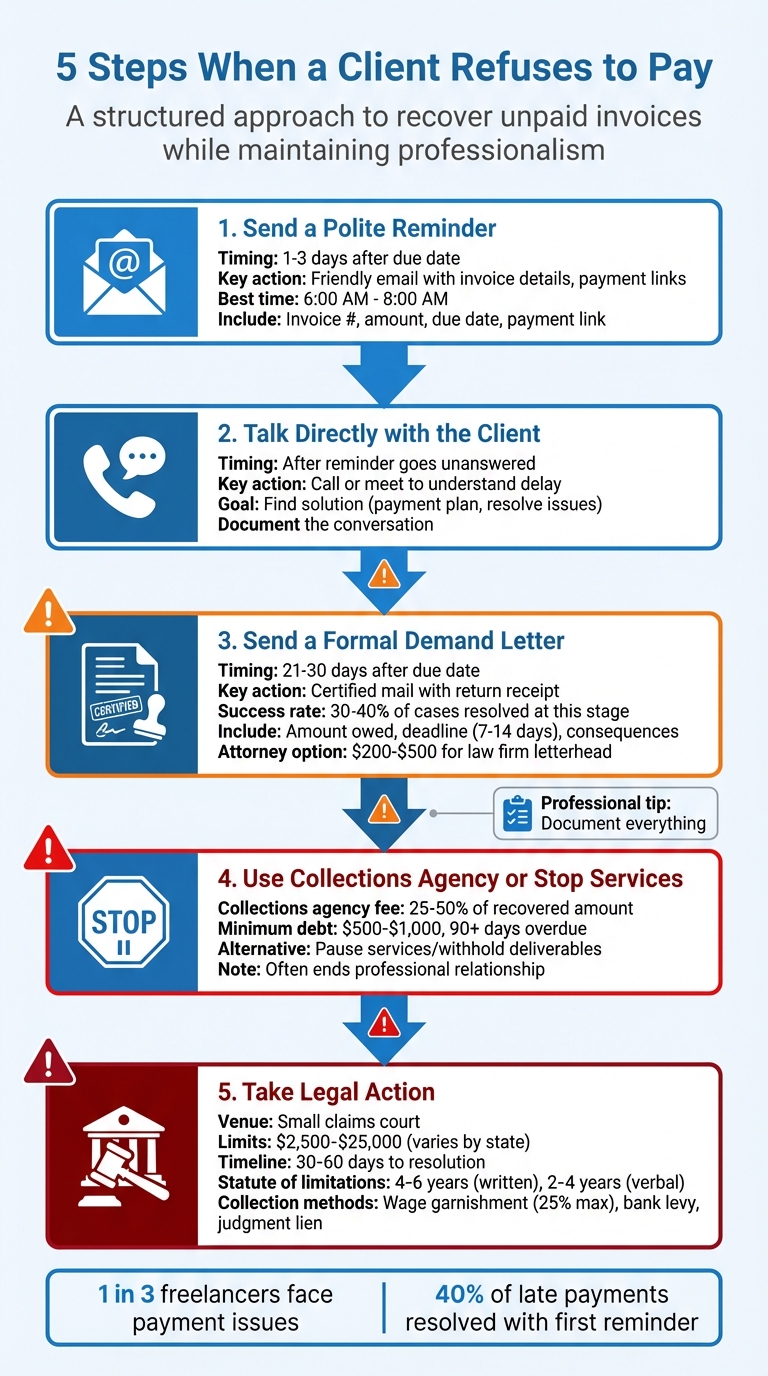
5-Step Process for Handling Client Non-Payment
Client Refuses to Pay A Step by Step Guide to Debt Recovery for Small Businesses!
sbb-itb-66f4c95
Step 1: Send a Polite Payment Reminder
When a payment is overdue, the first step is to send a friendly yet professional reminder email. Ideally, this should be done within 1–3 days after the due date, as delays are often unintentional oversights.
Your email should be straightforward and easy to act on. Use a clear subject line, such as "Payment Reminder: Invoice #12345", to ensure it grabs attention. In the body, mention the purpose of the email right away. Include key details like the invoice number, the total amount due (e.g., $1,250.00), the original due date, and payment instructions. To make things easier for the client, attach a PDF copy of the invoice so they don’t need to search for it.
"The trick is to write them in a way that's polite but not apologetic, firm without being rude, and clear enough that no one can miss what you're asking for." - Freya Laskowski, Founder and CEO of SERPManiac
To simplify the payment process, include direct links for payment options like Stripe, PayPal, or ACH transfers. Sending the email early in the morning (between 6:00 a.m. and 8:00 a.m.) can also help ensure it appears prominently in the recipient's inbox. Keep the tone helpful and avoid sounding accusatory, while inviting the client to reach out with any questions about the invoice.
How to Write a Payment Reminder
The tone of your reminder should balance professionalism with approachability. Begin with a neutral greeting and get straight to the point. Mention the invoice details - number, amount due, due date - and include a payment link. Avoid apologetic language like, "I'm sorry to bother you," as it can weaken your message.
Here’s an example of an effective reminder:
"Hi [Client Name],
Following up on Invoice #0042, $1,250.00, due 3/15/2026. Please let me know if you have any questions or need further clarification. You can pay directly using this link: [Payment Link].
Thank you for your prompt attention to this matter."
Double-check that the invoice is addressed to the correct contact and contains all necessary billing details. Once sent, document the communication immediately to ensure you have a record of your follow-up.
Keep Records of All Communication
It’s crucial to maintain a detailed record of every communication from the very first reminder. Save copies of emails, take screenshots with timestamps, and log any phone call details. This creates a paper trail that could be critical if the issue escalates to collections or legal action.
Track the dates and times of all reminders, note client responses (or lack thereof), and document any revised payment agreements. If you discuss the matter over the phone, follow up with an email summarizing the conversation. Keeping a well-organized file - whether digital or physical - ensures you’re prepared to handle disputes or escalate the matter if necessary.
Step 2: Talk Directly with the Client
If your reminder goes unanswered, it’s time to pick up the phone or schedule a meeting. A direct conversation grabs attention and signals that you’re serious about resolving the matter. The key here is to approach the discussion calmly and with a focus on business.
The goal isn’t to accuse or create conflict - it’s to get to the bottom of the issue and work toward a solution that benefits both sides. Keep the tone professional, sticking to the facts of your agreement and the work you’ve delivered.
"Chasing after a client for money you are owed doesn't have to be adversarial, and if you keep your communications straightforward and professional you can avoid damaging your relationship." - Shelly Garcia
This step acts as a bridge between initial reminders and actionable solutions, ensuring clarity and mutual understanding.
Find Out Why They Haven't Paid
Start the conversation with the assumption that the delay wasn’t intentional. Ask open-ended questions to uncover the reason behind the delay. For example: Did they receive the invoice? Are there any concerns about the quality of the work? Is the delay due to cash flow problems? Sometimes, the issue is as simple as an invoice being overlooked or stuck in a spam folder.
Take Tom’s story as an example. In May 2025, Tom, a caterer, was waiting on $6,500 for a wedding payment that was 10 days late. After sending a polite email, he followed up with a phone call. The client explained that a bank error had delayed the transfer. Thanks to Tom’s calm and professional approach, the payment was processed the very next day, and the client even referred him for future work. If you’re speaking with someone who doesn’t handle payments directly - like a project manager - ask for the contact details of the accounts payable team or the finance department.
Work Out a Payment Solution
Once you understand the reason for the delay, collaborate on a way forward. If the client is dealing with temporary cash flow issues, suggest a payment plan, such as splitting the total into installments (e.g., 50% now and 50% in 30 days). You could also offer a small discount for immediate payment if it helps resolve things faster. Use constructive language like, “I’m committed to finding a fair solution - can we discuss a payment plan?”
Consider Mike’s experience. In May 2025, Mike, a roofing contractor, faced a $12,000 dispute when a client questioned the quality of materials used. Through a mediated discussion, they agreed on a $10,000 settlement, paid in installments over 90 days. This avoided a costly lawsuit and preserved the working relationship. Whatever agreement you reach, set a specific deadline for payment and make it clear that any ongoing work will pause until the balance is settled.
Document What You Agreed On
After the conversation, follow up with an email summarizing the key points: the reason for the delay, the agreed payment amount, the schedule, and the deadline. If the agreement involves significant changes, like a payment plan, draft a formal written amendment for both parties to sign. This documentation ensures both sides are on the same page and gives you a clear record in case further action becomes necessary.
"A professional, systematic approach to collecting unpaid invoices isn't rude - it's business." - Collect Team
Step 3: Send a Formal Demand Letter
When direct conversations and reminders don't resolve the issue, it's time to take a more formal approach. Sending a demand letter is a key step in showing your seriousness about collecting the payment. Unlike an email, this is an official document that acts as a final warning and establishes a record of your efforts to resolve the matter before taking further action. It also underscores your professionalism and readiness to escalate if necessary.
Timing is critical. Ideally, send the demand letter within 21–30 days of the payment due date, after making at least two prior attempts to contact the client. Use certified mail with a return receipt requested to ensure proof of delivery - this can be crucial if you end up in small claims court.
Interestingly, around 30% to 40% of unpaid invoices are resolved shortly after clients receive a formal demand letter.
What to Include in a Demand Letter
Your demand letter should be straightforward and professional. Start by including your full name and address, the client’s name and business address, and the current date. In the body of the letter, clearly state the exact amount owed (including late fees, if applicable), the invoice number, and the original due date. Briefly describe the work or services you provided to show that you upheld your part of the agreement. Reference the original contract, including its payment terms (e.g., "Net 30").
The heart of the letter is your formal demand. Be clear and direct, such as: "I demand full payment of $6,500 by May 15, 2026." Set a specific deadline - usually 7 to 14 days from the letter's date - and outline what actions you will take if payment is not received. This could include filing in small claims court, involving a collections agency, or reporting the debt to credit bureaus. Use bold text to highlight both the total amount owed and the deadline to ensure these details stand out.
Attach supporting documents like the original contract, invoices, and relevant email correspondence. This evidence strengthens your case and shows you’ve taken an organized, professional approach.
Get Help from an Attorney
For larger debts or when dealing with corporate clients, it’s often worth hiring an attorney to draft and send the letter on their law firm’s letterhead. This can cost between $200 and $500 but sends a strong signal that you’re prepared to take legal action.
"A letter written on a lawyer's letterhead, with all that suggests, is going to have a better impact than one written by a frustrated vendor." - Shelly Garcia
If the debt is smaller (under $1,000), you can write the letter yourself using a professional template, which typically costs between $0 and $50. However, be prepared to follow through on any consequences you outline. Making empty threats can harm your credibility.
Step 4: Use a Collections Agency or Stop Services
If your previous efforts, like sending formal demand letters, haven't worked, it might be time to take stronger action. You can either hire a collections agency or halt your services to encourage payment.
"A client who won't pay isn't a relationship worth keeping." – Collect Team
Collections Agencies
A collections agency can take over the recovery process by sending formal demands, making calls, and even reporting unpaid debts to credit bureaus, which can seriously affect a client’s credit score. These agencies usually charge a fee of 25% to 50% of the amount they recover. They often focus on debts that are at least $500 to $1,000 and overdue by 90 days or more.
Before hiring an agency, check that they’re licensed in your state and research their reputation. Keep in mind that this step is often a last resort, as it usually ends any chance of continuing the professional relationship with the client.
If you’d rather not outsource collections, pausing your services can be another effective option.
Pausing Services
Stopping your services can be a powerful way to gain leverage, particularly if the client relies on your ongoing work. This is especially true for projects involving deliverables like hosting, maintenance, or final files. First, review your contract to ensure it includes clauses about ownership transfer or cancellation. If the contract specifies that ownership only transfers after full payment, you’re within your rights to suspend work.
For digital projects, you might withhold items such as high-resolution files, website credentials, or hosting access until payment is made. If you’re mid-project, consider holding back final deliverables rather than completing and launching the work.
"If a client refuses to pay for ongoing services, it may be time to withhold deliverables and stop all work." – Housecall Pro
Inform the client that work will remain paused until payment is received. You can also make it clear that future projects will require full upfront payment to avoid similar issues. If the client is facing temporary cash flow problems rather than refusing to pay outright, you could propose a payment plan - but keep the work on hold until at least the first installment clears.
Both of these approaches often signal the end of the working relationship. Carefully consider your options, especially if the client is insolvent or bankrupt, as recovering your money in such cases may be unlikely.
Step 5: Take Legal Action in Small Claims Court
If reminders, direct conversations, formal letters, and even suspending services haven't worked, the next logical step is taking legal action. Small claims court is often the go-to option for freelancers seeking unpaid compensation when other approaches fail.
This legal avenue is specifically designed for disputes over smaller amounts, typically ranging from $2,500 to $25,000, depending on which state you’re in.
"Small claims court is an essential component of the U.S. legal system, designed specifically for the general public to settle disputes involving relatively modest amounts of money." – Sarah Edwards, Contributor, ConsumerShield
Before proceeding, make sure your claim falls within the statute of limitations - 4 to 6 years for written contracts and 2 to 4 years for verbal agreements. Filing fees will vary by state, so check the costs in your area.
How to File in Small Claims Court
First, confirm your claim doesn’t exceed your state’s monetary limit. For example, California allows individuals to file claims up to $12,500 (though corporations are capped at $6,250), while Texas permits claims up to $20,000, and Florida’s limit is $8,000. If the amount owed slightly exceeds the limit - say $11,000 in a state with a $10,000 cap - you can waive the excess amount to take advantage of the quicker and less expensive small claims process.
Next, gather the defendant’s full legal name or their registered business name. You’ll need this information to file in the appropriate county - typically where the defendant lives, operates, or where the contract was signed. Obtain a "Statement of Claim" form from your local court clerk or their website and complete it with details about the debt and the dispute.
Once filed, you must notify the client through a legal process called "service of process." This costs between $20 and $100, depending on your state, and can be done via personal service, certified mail, or through a sheriff. Prepare at least three copies of your evidence - such as contracts, invoices, emails, and work records - and organize them in chronological order.
"Small claims judges make decisions based on documents, not arguments." – SmallClaimsHelper
To make your case clear and concise, organize your documents in a binder with labeled tabs. Create a one-page summary highlighting key dates and amounts, and practice explaining your case in under two minutes - judges appreciate brevity.
Once your claim is filed, your focus should shift to enforcing the judgment if you win.
Collecting Payment After Winning
Winning in small claims court doesn’t automatically mean you’ll receive payment. You’ll need to take further steps to enforce the judgment. One option is obtaining a writ, such as an execution, garnishment, or attachment, to collect the funds owed.
- Wage garnishment: You can collect up to 25% of the debtor’s net wages by providing their employer’s details to the sheriff.
- Bank account levy: If you know the debtor’s bank and account information, funds can be seized directly. Old checks they’ve sent may have the necessary details.
- Judgment lien: By recording a lien against the debtor’s real estate, you’ll secure payment if they sell or refinance the property.
Money judgments are valid for 5 to 20 years and can often be renewed, but it’s worth assessing whether the debtor has any non-exempt assets or income. If not, they may be considered "judgment proof", meaning collection efforts will have to wait until their financial situation improves.
When You Need a Lawyer
While small claims court is designed for self-representation, there are times when hiring a lawyer makes sense. For instance, if the debt exceeds the small claims limit, involves complex intellectual property issues, or requires filing a mechanic’s lien for property improvements, legal help can be invaluable.
Some jurisdictions offer additional protections that make legal action worthwhile. For example, New York City’s "Freelance Isn’t Free Act" allows freelancers to recover double damages and attorney’s fees in cases of non-payment. If you’re dealing with a large corporation or a particularly complicated contract, the potential recovery may justify the cost of legal counsel.
"Small claims court is generally quicker, and more affordable than filing your lawsuit in other types of courts, plus you generally don't need a lawyer to sue in small claims." – JusticeDirect
Most small claims cases are resolved within 30 to 60 days, making it a faster alternative to traditional litigation. However, even after winning, be prepared for the extra effort required to collect your payment.
Prevent Payment Problems with Paid on Time

Recovering unpaid invoices is important, but wouldn’t it be better to avoid those headaches altogether? A proactive strategy can save you the trouble of chasing payments in the first place.
Paid on Time is built to tackle payment disputes before they even start, sparing freelancers from drawn-out legal battles. The platform ensures clients secure a payment method upfront, eliminating common excuses like "cash flow issues" or "lost invoices". Once you’ve completed the project, you can charge the secured payment method with a single click - no more waiting for net-30, net-60, or even net-90 payment terms.
This system shifts the balance of power. Instead of delivering work and hoping for payment, you retain control throughout the project. Additionally, the platform sets up clear, legally binding agreements that outline the project scope, payment details, and deadlines.
What Paid on Time Offers
Paid on Time delivers three key advantages that traditional invoicing just can’t match:
- Secured Payment Methods: Clients commit to paying before work begins by securing their payment method upfront.
- Legally Binding Agreements: Payment terms, project scope, and deadlines are clearly defined, reducing room for disputes.
- One-Click Payment: Once your work is done, you can charge the client immediately, ensuring predictable cash flow instead of waiting weeks or months.
The platform charges a simple 5% fee per transaction - only when you actually get paid. There are no monthly fees, hidden expenses, or risks of unpaid invoices. Each transaction comes with thorough documentation, making it easier to resolve disputes if they arise.
Paid on Time vs. Manual Invoicing
The difference between Paid on Time and traditional invoicing is night and day. Here’s how they stack up:
| Feature | Manual Invoicing | Paid on Time |
|---|---|---|
| Payment Risk | High; depends entirely on the client paying after delivery. | Low; payment method is secured beforehand. |
| Follow-up Required | Time-consuming and stressful. | Minimal and automated. |
| Freelancer Leverage | Limited; little recourse after delivering work. | Strong; you control when deliverables are released. |
| Cash Flow | Unpredictable; delayed by net-30, net-60, or longer terms. | Reliable; charge instantly upon completion. |
| Legal Standing | Often based on vague emails or verbal agreements. | Backed by structured, legally binding contracts. |
| Cost | "Free", but with hidden costs like unpaid invoices and wasted time. | 5% of the payment, only when you get paid. |
Manual invoicing leaves freelancers exposed to all the risks we've covered earlier. Paid on Time offers a proactive alternative, helping you sidestep those challenges entirely. By securing payment upfront, you can focus on your work without worrying about whether - or when - you’ll get paid.
Wrapping It Up
Handling non-payment requires a methodical approach. Start with a polite reminder - about 40% of late payments are resolved with just a friendly nudge. If that doesn’t work, move on to direct communication to identify the problem and explore a solution. Should the issue persist, a formal demand letter can act as a final warning while creating a documented record for legal purposes. If all else fails, collections agencies or small claims court may be necessary, though these options can be more time-intensive and costly.
Throughout the process, professionalism is key. Around 1 in 3 freelancers encounter payment issues at some point. As Steve Pomerantz from Millo.co advises:
"You need to emotionally detach as much as possible because the best moves you can make often aren't the ones your heart will dictate".
It’s important to avoid venting frustrations publicly or making decisions out of anger. Stick to the facts, maintain composure, and approach the situation with a clear, business-focused mindset.
Once you've tackled the immediate issue, think about how to safeguard future projects. This guide outlines a complete process - from initial reminders to legal action - that not only helps recover overdue payments but also lays the groundwork for a more reliable payment system. Tools like Paid on Time can simplify this by ensuring payment methods are secured upfront and allowing you to charge clients with one click after completing work. By following these steps, you can reduce disputes, minimize delays, and maintain control over your projects from start to finish.
FAQs
When should I stop work if a client won’t pay?
If a client refuses to pay despite your best efforts, it’s time to stop work. Start by reviewing your contract to ensure you’ve upheld your end of the agreement. Then, send polite but firm follow-ups and multiple reminders to request payment. If the client still doesn’t respond or outright refuses to pay, you may need to escalate the situation.
Consider sending a formal demand letter as a final attempt to resolve the issue. If that doesn’t work, explore legal options, such as small claims court or consulting an attorney. At this point, it’s best to halt all work until the matter is resolved. Continuing without payment only adds to your losses.
What proof should I save before taking legal action?
Before moving forward with legal action over an unpaid invoice, make sure to gather and organize important documents that back up your claim. This should include the signed contract or agreement, detailed records of all communication (such as emails, messages, or call logs), and proof that the work was completed and delivered. Examples of this proof could be project files, timestamps, or delivery confirmations. These documents will help demonstrate the validity of your claim and show that you made attempts to resolve the matter before taking legal steps.
How does Paid on Time prevent non-payment?
Paid on Time works to minimize the risk of non-payment by enabling freelancers and businesses to:
- Set clear agreements upfront: Establish expectations and terms before any work begins.
- Secure payment methods in advance: Ensure clients provide payment details beforehand.
- Easily charge clients: Complete the transaction with a single click once the job is done.
By following these steps, disputes are reduced, payments are received on time, and cash flow remains consistent.