Freelance Payment Terms: What to Include in Contracts
Freelance Payment Terms: What to Include in Contracts
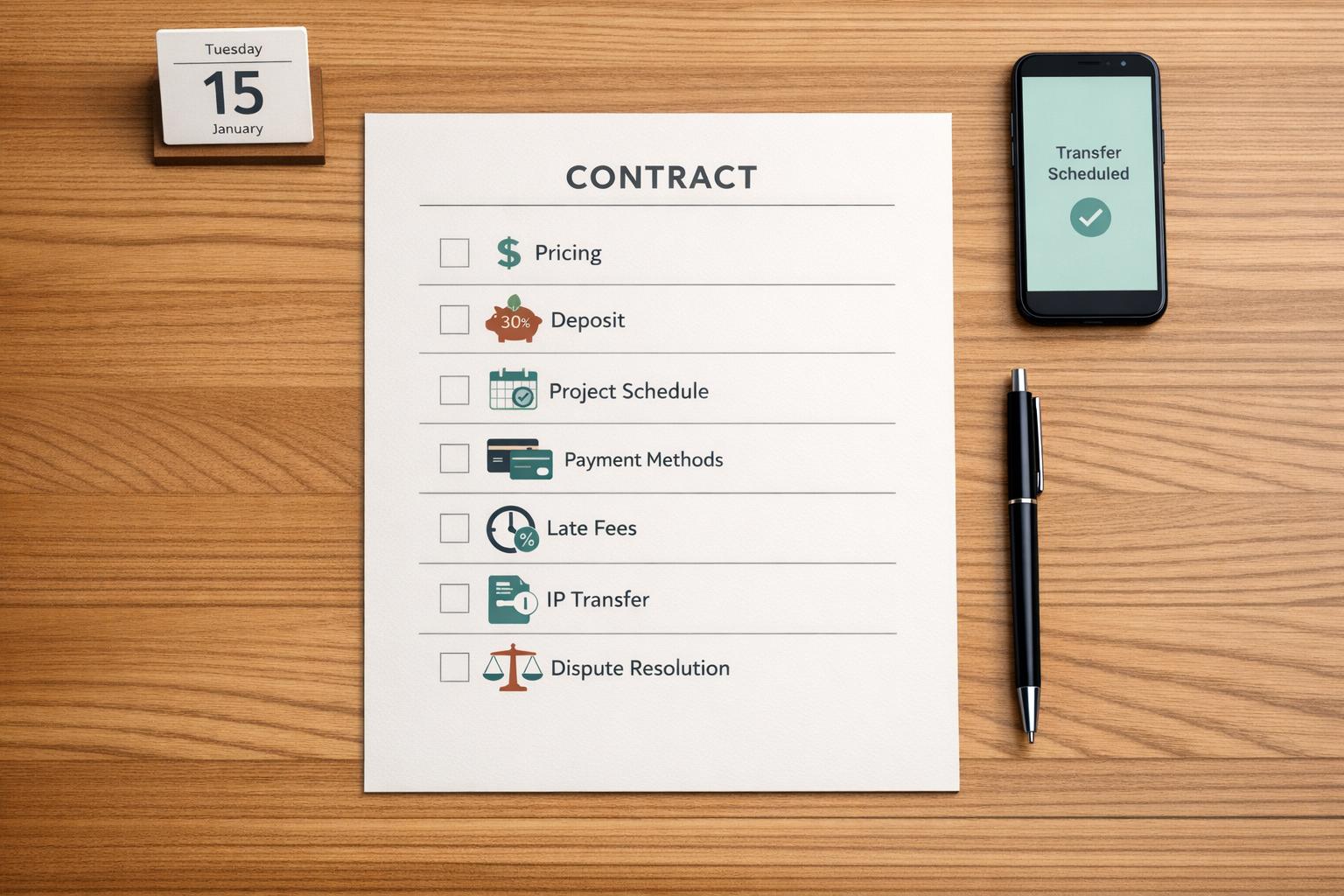
Freelancers often face late or unpaid invoices, but clear payment terms in contracts can help solve this. Here's what you need to know:
- Define Payment Amount & Scope: Clearly outline costs, deliverables, and what's excluded to avoid scope creep.
- Choose Pricing Models: Options include hourly rates, flat fees, milestone payments, or retainers.
- Set Payment Schedules: Use specific deadlines like "Net 15" or "Net 30" and request upfront deposits (30%-50%).
- Outline Payment Methods: Specify accepted methods (ACH, PayPal, etc.) and who covers fees for international transactions.
- Include Late Fees & Penalties: Add interest on overdue payments (e.g., 1.5%-5% monthly) or offer early payment discounts.
- Protect Intellectual Property: Transfer ownership only after full payment and clarify portfolio rights.
- Address Disputes: Set a dispute window (5-10 days) and include a "work stop" clause for overdue invoices.
Clear contracts not only secure your income but also simplify client relationships. Avoid vague terms, missing payment details, and undefined scopes to ensure timely payments. Start using these strategies to protect your work and get paid on time.
How to Create a Freelancer Contract (Step-by-Step Tutorial!)
sbb-itb-66f4c95
Payment Terms Every Freelance Contract Needs
A solid freelance contract should include clear payment terms to protect your income and set expectations from the start. Here’s what to include.
Payment Amount and Project Scope
Start by specifying the total project cost. For multi-part projects, include an itemized breakdown. For instance, a web design project might detail: homepage design ($2,000), three interior pages ($1,500), and mobile optimization ($500), totaling $4,000.
Just as important as what you’re delivering is what you’re not delivering. Clearly define the scope of work to avoid scope creep - those extra requests that sneak in without extra pay. As writer and strategist Stefan Palios points out:
A signature on a contract gives you ammo later if the client is trying to skip out on payment. In your clause, don't forget to indicate that you will charge any applicable taxes, as you don't want that to be a surprise come invoice time.
If working with international clients, specify the currency (e.g., USD) and include a clause stating that intellectual property rights transfer only after full payment is received.
Once the scope and payment amount are outlined, you can choose the pricing structure that works best for the project.
Pricing Structure Options
Your pricing model should align with the nature of the project. Here are a few common options:
- Hourly rates: Ideal for projects with a flexible or undefined scope. You bill for the actual time worked.
- Flat fees: A set price for the entire project. It’s straightforward but can be risky if you underestimate the effort required.
- Milestone payments: Break large projects into phases, with payments tied to specific deliverables. For example, 25% upfront, 25% after the first draft, and 50% upon completion. This ensures steady cash flow and reduces risk.
- Retainers: Clients pay upfront to reserve your time, either for a set period or a specific number of hours. This model provides more predictable income.
Once you’ve chosen a pricing structure, define payment schedules that align with your financial needs.
Payment Schedules and Due Dates
Define clear payment deadlines using Net terms, which specify how many days after the invoice date payment is due. While Net 30 is standard, freelancers often benefit from shorter terms like Net 15 or Net 7 to maintain better cash flow. Avoid vague terms like "upon receipt" and replace them with specific deadlines, such as "15 days after the invoice date".
Requesting an upfront deposit - typically 30% to 50% - is another way to protect your time and filter out unreliable clients. Developer Matt Fulton explains:
Asking a client to pay before they have seen your work can feel uncomfortable... but deposits are a common practice in service businesses. If a client is reluctant to pay a deposit, this may be a sign that they'll be reluctant to pay future invoices.
Also, ensure your contract specifies that payment is due when the work is complete, not when the client "approves" it. This prevents delays caused by internal client reviews. Including a "work stop" clause for overdue invoices can also protect you from unpaid labor.
Payment Methods and Invoicing Requirements
Next, outline acceptable payment methods to avoid confusion or delays. Include options like ACH/direct deposit, credit cards, wire transfers, or platforms like PayPal or Stripe. For international clients, clarify who covers transaction and exchange fees.
Set clear invoicing standards in the contract. Each invoice should include a unique invoice number, issue date, and due date. For corporate clients, ask for their Purchase Order (PO) number and confirm the correct Accounts Payable contact, as the person managing the project may not handle payments.
Legal experts emphasize that clear, written rules make payment processing smoother.
Late Fees and Payment Penalties
Late fees serve as both a deterrent and compensation for chasing overdue payments. A typical charge is 1.5% to 5% monthly interest on overdue balances. Include a grace period (usually 5–7 days) in your contract, along with the exact late fee percentage or fixed amount.
To encourage early payments, consider offering a small discount. For example, "2/10 Net 30" means the client gets a 2% discount for paying within 10 days, but the full amount is due in 30 days if they don’t.
Extra Contract Protections for Cash Flow Security
Beyond basic payment terms, including specific contract clauses can safeguard your cash flow and help avoid disputes.
Written Records of Payment Agreements
Make sure your contract reflects the exact deliverables and pricing discussed in email exchanges. This ensures the client agrees to the precise scope of work. Include a "Relationship of the Parties" clause to clarify that you are an independent contractor, not an employee - highlighting that you control your work hours and are only responsible for the agreed tasks.
Consider adding a "Choice of Law" clause to specify which state's laws will govern any payment disputes, typically your home state. Including a severability clause is also a smart move. This ensures that if one part of the contract becomes invalid, critical sections like payment and intellectual property clauses remain enforceable.
Additional Costs and Expense Reimbursements
Be clear about reimbursable expenses such as travel, stock photos, materials, or venue fees, and require prior written approval for these costs. This protects you from disputes over rejected expense claims. Also, include a clause stating that expenses will be billed at their actual cost without any markup.
Define how many revisions are included in the project’s base price, and specify the hourly rate or fee for additional edits. If the work requires rush delivery during weekends, evenings, or holidays, disclose any applicable surcharges upfront. For projects involving physical goods, outline responsibilities for shipping costs and clarify who is liable for damages during transit.
These measures, combined with intellectual property protections, provide a solid financial safety net.
Intellectual Property Rights
Strengthening IP clauses can further protect your earnings and clarify ownership terms.
Include an "IP Assignment upon Final Payment" clause to ensure ownership of the work transfers only after full payment is received. This prevents clients from using your work without fulfilling their payment obligations. As writer and strategist Stefan Palios advises:
Put a clause that IP does not transfer ownership to the client until they pay you. This will give you a level of protection from a client that refuses to pay but starts to use what you've produced for them.
Additionally, specify whether you retain the right to showcase the finished work in your portfolio for self-promotion. Clarify who owns drafts, sketches, or any unused versions of the work, so there’s no misunderstanding about intellectual property rights.
How to Write Clear Contract Payment Clauses
Clear payment clauses in contracts are essential for maintaining steady cash flow and fostering strong professional relationships with clients. Using precise, straightforward language eliminates confusion and ensures both parties fully understand their responsibilities. The aim is to leave no room for ambiguity, so everyone knows exactly what’s expected.
Payment Authorization and Agreement Terms
Contracts should separate the payment agreement from the payment authorization, as they serve distinct purposes. The payment agreement outlines the amount, due date, and conditions, while the payment authorization grants permission to charge a specific card or account:
A payment agreement defines the obligation; payment terms define the mechanics.
Having both a signed payment agreement and authorization provides legal clarity, confirming the client’s acknowledgment of the debt and their consent to payment collection. This two-step approach is especially helpful in resolving disputes.
When drafting payment clauses, always use active language. For example, say "Customer shall pay all invoices within 15 calendar days from the invoice date" instead of using passive phrases like "Invoices are payable within 15 days." Attorney Matthew S. Johnston emphasizes the importance of active phrasing:
The word 'payable' does not convey any action or imperative to act. The sentence is more of a definition than an obligation.
Set deadlines based on the invoice date, not the date the client receives it, as receipt can be difficult to verify. Use clear section titles like "Invoices and Payment" to immediately highlight financial obligations.
Finally, address tax responsibilities to avoid misunderstandings.
Tax Responsibilities
Your contract should clearly state that the client is responsible for taxes, surcharges, and government fees. A simple sentence like "Client is responsible for all applicable sales tax, government fees, and surcharges" prevents surprise deductions from your payment. Be explicit about whether your prices include or exclude taxes to avoid confusion when the invoice is issued.
For international clients, specify that payments must be made in U.S. dollars (USD). Including a clause such as "All payments must be made in USD" protects you from currency exchange risks and ensures clarity for both parties.
Once payment and tax terms are defined, it's important to outline procedures for handling disputes.
Dispute Resolution Procedures
Include a dispute window in your contract, giving clients a set period - typically 5 to 10 days after receiving an invoice - to raise any billing concerns. After this timeframe, the invoice is considered accepted and undisputed. This prevents payment delays under the pretense of "reviewing" charges.
Incorporate a "notice and cure" period that requires clients to notify you in writing of any payment issues and allows them a specified number of days (commonly 15 to 30) to resolve the problem before legal action is taken. As Greg Mitchell points out:
Most payment disputes start with unclear expectations, not bad intent.
Maintain thorough transaction records, including the signed agreement, payment authorization, invoices, receipts, and documentation of any scope changes. This "billing packet" is invaluable if you need to pursue collections or legal action. Additionally, include a clause in your contract that allows you to pause all work immediately if a payment is overdue. This creates a sense of urgency for clients to settle their invoices promptly.
Payment Term Mistakes to Avoid
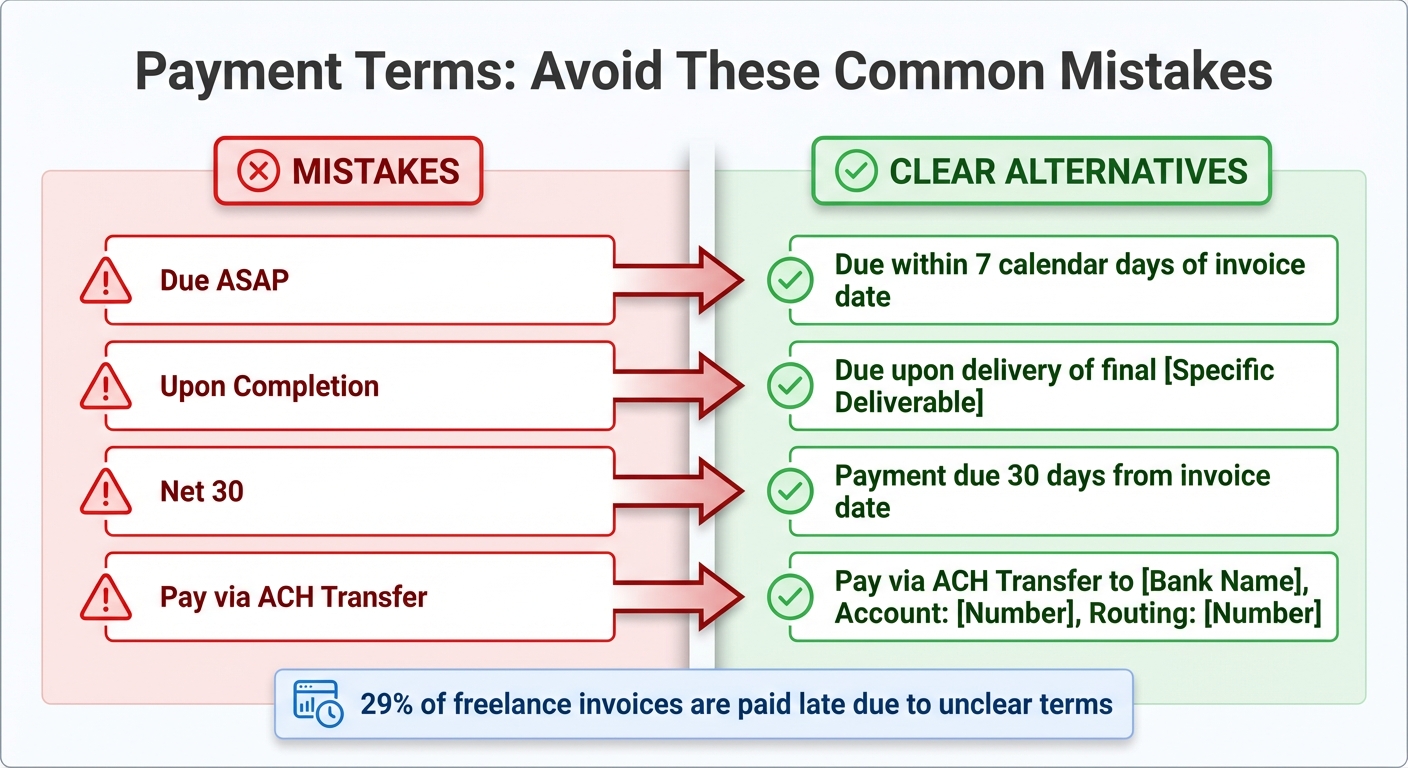
Common Payment Term Mistakes vs Clear Alternatives for Freelance Contracts
Even with well-defined payment terms, small drafting errors can disrupt your cash flow. These mistakes can lead to delayed payments and financial uncertainty. Understanding these common pitfalls can help you create contracts that safeguard your income.
Vague or Unclear Language
Phrases like "ASAP", "Net 30", or "due upon completion" might seem straightforward, but they often cause confusion. For example, "due upon completion" could be interpreted as payment after client satisfaction rather than when a specific milestone is met. This lack of clarity contributes to the fact that 29% of freelance invoices are paid late.
To avoid ambiguity, use specific dates or clear payment triggers. Instead of "Net 30", write "Payment due within 30 calendar days from the invoice date." Replace "ASAP" with "Payment due within 7 calendar days of invoice date." Matt Fulton, a developer and Freelancers Union member, noted in 2016 that unclear contract language was a key reason many freelancers struggled to get paid.
Also, avoid using industry jargon that clients might not understand. Clear, precise terms reduce the risk of misunderstandings.
Missing Payment Instructions
Incomplete invoicing details can give clients a valid reason to delay payments. Missing information - such as your tax ID, payee name, account numbers, or payment method options - can result in your invoice being stuck in administrative limbo.
Always include full remittance details in your contract and invoices. Specify all accepted payment methods (e.g., ACH transfer, PayPal, wire transfer, credit card) and provide the necessary account details for each. For example, include your bank name, account number, and routing number for ACH transfers, or direct payment links for online methods. This reduces processing delays.
Additionally, clearly identify the billing contact in your contract. The person overseeing your project isn't always the one handling invoices. Include the name, email, and phone number of the Accounts Payable contact, and send invoices directly to them, with a copy to your project contact. These steps ensure your invoices are directed to the right person and processed promptly.
Undefined Scope and Change Requests
When deliverables and revision limits aren't clearly defined, clients may dispute whether the work is complete or continue requesting changes, delaying payment in the process.
Be specific about deliverables and include the number of revisions allowed. For example, outline exactly what will be delivered and limit revisions to two or three rounds. This makes it harder for clients to argue you haven't fulfilled your obligations.
Include a formal change request process in your contract. State that work beyond the agreed-upon scope requires written approval and will incur additional fees - either a fixed amount or an hourly rate. You can also add a "What I Won't Do" list, as suggested by writer and strategist Stefan Palios, to clarify boundaries and avoid misunderstandings about what’s included in the base price.
| Common Mistake | Clear Alternative |
|---|---|
| "Due ASAP" | "Due within 7 calendar days of invoice date" |
| "Upon Completion" | "Due upon delivery of final [Specific Deliverable]" |
| "Net 30" | "Payment due 30 days from invoice date" |
| "Pay via ACH Transfer" | "Pay via ACH Transfer to [Bank Name], Account: [Number], Routing: [Number]" |
Conclusion
This guide has highlighted the key elements every freelancer should include in their contracts to ensure timely payments.
By outlining clear payment terms - such as upfront deposits, milestone payments, late fees, and invoicing requirements - you can avoid the confusion that often leads to delays. These details not only protect your income but also establish you as a professional who takes their work seriously.
Payments accelerate when contractual rules are clear. - Greg Mitchell, Legal Consultant, AI Lawyer
Consistency is the foundation of financial stability. Standardizing your terms, automating invoicing, and billing regularly - whether weekly for hourly work or by milestones for fixed projects - can help maintain a steady cash flow. These habits demonstrate professionalism and make it easier for clients to pay on time.
Unclear terms are a common cause of late payments. By incorporating practices like setting specific due dates and providing detailed payment instructions, you can turn what’s often a stressful aspect of freelancing into a smooth, predictable process. Your contracts should make it simple for clients to pay promptly.
Use these strategies in your next contract to reduce disputes, speed up payments, and focus on what you do best - delivering quality work. Clear, well-thought-out payment terms are the foundation of a steady and reliable income.
FAQs
What deposit amount should I ask for?
As a freelancer, it's typical to ask for an upfront deposit ranging from 25% to 50% of the total project cost. This is a common practice for smaller projects. For larger projects, a lower percentage - around 10% to 20% - might make more sense. To safeguard your time and effort, you might want to make the deposit non-refundable. Just be sure the deposit amount matches the size and complexity of the project.
How do I choose between Net 7, Net 15, and Net 30?
Choosing between Net 7, Net 15, and Net 30 terms comes down to your cash flow requirements, the nature of your client relationships, and what’s standard in your industry.
- Net 7: Payments are due within 7 days of invoicing. This is a great option for smaller projects or when working with clients you trust to pay quickly. It helps maintain a steady cash flow.
- Net 15: Payments are due within 15 days. This strikes a middle ground and works well for ongoing projects or medium-sized clients who may need a bit more time to process invoices.
- Net 30: Payments are due within 30 days. This is widely used with larger clients or corporate accounts but can stretch your cash flow since payments take longer to come in.
Each option has its pros and cons, so consider what aligns best with your financial needs and client base.
What should I do if a client won’t pay?
First, take a close look at your contract. Check the payment terms, deadlines, and any late fee policies you’ve agreed upon. This will give you a clear understanding of what you’re entitled to and help guide your next steps.
Next, resend the invoice with a polite follow-up email or message. Sometimes, clients simply forget or overlook payment deadlines, so this gives them a chance to address the issue without any tension.
If that doesn’t work, you might need to send a formal demand letter. This step signals the seriousness of the situation and can often prompt action.
As a final measure, you could escalate the matter by seeking legal action or hiring a collection agency. These options are more aggressive but may be necessary if all other attempts fail.
To avoid issues like this in the future, make sure your contracts are crystal clear and keep detailed records of all communications. This documentation can be invaluable in protecting your rights.