Legal Options for Unpaid Freelancers
Legal Options for Unpaid Freelancers
Freelancers often face unpaid invoices, with 40%–55% of cases involving clients who delay or refuse payment. This disrupts cash flow and creates financial stress. Here's how you can recover unpaid invoices and protect yourself in the future:
- Start with reminders: Send polite payment reminders within 1–3 days of the due date. Escalate to firmer follow-ups and phone calls if needed.
- Send a demand letter: If reminders fail, issue a formal demand letter with clear payment details and deadlines.
- Explore legal options: Use small claims court for debts under state limits (e.g., $3,500–$25,000 depending on location). Mediation and debt collection agencies are alternatives, though they may involve fees.
- Prevent future issues: Use contracts with clear payment terms, request deposits or milestone payments, and consider tools like Paid on Time to secure funds upfront.
Key Takeaway: Combine proactive measures like contracts and upfront payments with structured recovery steps to minimize risks and recover unpaid earnings effectively.
Getting Paid Late for Work: how to collect on Past Due Invoices
sbb-itb-66f4c95
Steps to Take Before Legal Action
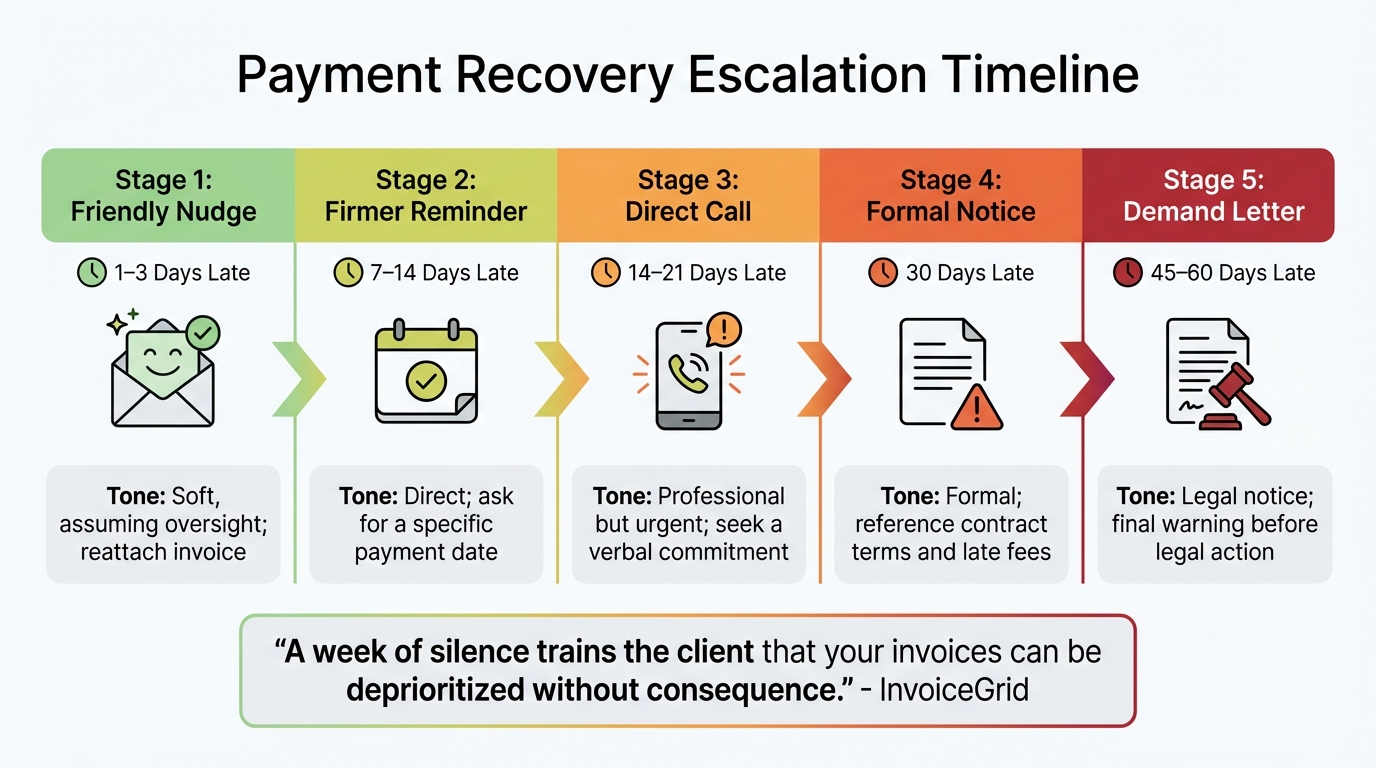
5-Stage Escalation Timeline for Recovering Unpaid Freelance Invoices
Before jumping into legal proceedings, it’s worth trying some straightforward strategies to recover your money. These steps can often resolve the issue without the added expense of legal fees.
Send Payment Reminders
Late payments are often just the result of simple mistakes - clients might forget an invoice because of busy schedules or internal hiccups. That’s why your first step should be sending a polite reminder within 1 to 3 days after the due date. If you wait too long, it might send the message that late payments don’t matter.
When sending a reminder, include all the important details: the invoice number, the amount due, the due date, and payment options. Reattaching the invoice can also make things easier for the client. If you use bookkeeping software like QuickBooks or FreshBooks, you can automate these reminders to save time.
Maintain professionalism by following a clear escalation process. Start with a friendly email, then move to firmer reminders, and if there’s no response after 14 to 21 days, make a phone call to get a verbal commitment. As InvoiceGrid explains:
"A week of silence trains the client that your invoices can be deprioritized without consequence." (InvoiceGrid)
Here’s a quick guide to an escalation timeline:
| Escalation Stage | Timing | Recommended Tone |
|---|---|---|
| Friendly Nudge | 1–3 Days Late | Soft, assuming oversight; reattach invoice |
| Firmer Reminder | 7–14 Days Late | Direct; ask for a specific payment date |
| Direct Call | 14–21 Days Late | Professional but urgent; seek a verbal commitment |
| Formal Notice | 30 Days Late | Formal; reference contract terms and late fees |
| Demand Letter | 45–60 Days Late | Legal notice; final warning before legal action |
If the client mentions cash flow problems, consider offering a payment plan or milestone billing. This approach can help recover your money while keeping the business relationship intact.
Issue a Demand Letter
If reminders don’t work, the next step is to send a formal demand letter. This document should outline the amount owed, set a deadline (usually 7 to 14 days), and explain that legal action may follow if payment isn’t made.
Make sure to include the following in your letter:
- Your contact information and the client’s details
- A description of the services provided
- The original invoice amount and date
- Any partial payments made
- The total balance due, including late fees or interest (if allowed by your contract)
- Your preferred payment methods
Keep the tone professional and stick to the facts. Avoid letting emotions influence your message. As Michelle Wilson, Founder of Wilson Murphy Law, advises:
"A short pause now can save you hours later. Nonpayment often looks personal, but it's usually one of a few predictable patterns. Start with facts, not feelings, because facts are what help you get paid."
Send the demand letter via certified mail with a return receipt requested. This provides proof of delivery, which can be crucial if the situation escalates to court. Additionally, some states allow statutory prejudgment interest on unpaid balances, such as 10% per year in California, 9% in New York, 6% in Texas, and 5% in Illinois.
If you’re still working with the client on other projects, it may be wise to pause ongoing work until the outstanding balance is resolved.
Review Contracts and Keep Records
Your contract and related documentation are your strongest tools in these situations. Without a written agreement, resolving disputes can become much harder.
Start by reviewing your original contract to identify clauses related to late fees, interest rates, or cancellation fees. Then, create a detailed timeline of events, including the contract signing date, work completion dates, invoice issuance, and all follow-up communications.
Document every interaction with the client. For instance: "Spoke with Jane Smith on 3/15/2026; she promised payment by 3/22/2026."
This paper trail not only shows your attempts to resolve the issue in good faith but also strengthens your case if legal action becomes necessary. For example, under California’s "account stated" rule, a client’s failure to dispute an invoice within a reasonable time can imply acceptance of the amount owed.
Keep copies of all relevant documents, such as:
- Signed contracts
- Itemized invoices
- Receipts for partial payments
- Deliverables
- Time-tracking logs
- Client approval emails
- Demand letters sent via certified mail
These records will support your case if you decide to pursue mediation or legal action later on.
Legal Options for Recovering Unpaid Invoices
When reminders and demand letters fail, freelancers can explore legal paths to recover unpaid invoices. The right choice will depend on factors like cost, complexity, and the likelihood of success.
Mediation offers a way to resolve disputes without heading to court. This involves a neutral third party who helps both sides reach an agreement, making it a quicker and less adversarial option - especially if maintaining the client relationship is a priority. In some areas, mediation is a required step before filing a lawsuit, so it's worth checking local regulations. While mediators don't make binding decisions, they can guide discussions toward solutions like payment plans or partial settlements. If mediation doesn't work or isn't appropriate, more formal legal options, such as small claims court, may be necessary.
Small claims court is a practical choice for freelancers, as it allows you to represent yourself, keeping costs low. Filing fees typically range from $30 to $300, with total costs usually falling between $300 and $500. Each state sets its own maximum claim limit, ranging from $3,500 in Arizona to $25,000 in Delaware. If the amount owed exceeds your state's limit, you can choose to waive the excess to stay within small claims court and avoid the higher expenses of civil court. Success often hinges on having strong documentation, like contracts, invoices, and communication records, with success rates averaging 60–70%. Attorney Cara O'Neill explains:
"Small claims court is particularly cost-effective for collecting unpaid bills because it eliminates the need for bill collectors and lawyers -- who often keep, as their fee, up to half of what they collect."
For clients who remain unresponsive, other approaches, such as debt collection or bankruptcy claims, might be necessary.
Debt collection agencies can handle overdue invoices, especially those unpaid for over 90 days. These agencies typically work on contingency, taking 25%–50% of the recovered amount. They also report debts to credit bureaus, which can pressure clients to pay. While their expertise can save you time, there's no guarantee of success. To avoid potential issues, ensure any agency you consider is properly licensed and clear about its fees.
Bankruptcy claims become relevant if a client files for bankruptcy. In such cases, you'll need to submit a proof of claim with the bankruptcy court to seek repayment. However, unsecured creditors often recover only a small portion of what's owed, as secured and priority claims take precedence.
How to Prevent Future Payment Problems
Securing payments upfront is one of the most effective ways to avoid unpaid invoices. With more than 70% of freelancers facing non-payment issues at some point in their careers, taking steps to protect yourself early can save you from potential legal hassles later. Here’s how you can minimize risks and ensure you get paid for your work.
Use Paid on Time for Payment Security
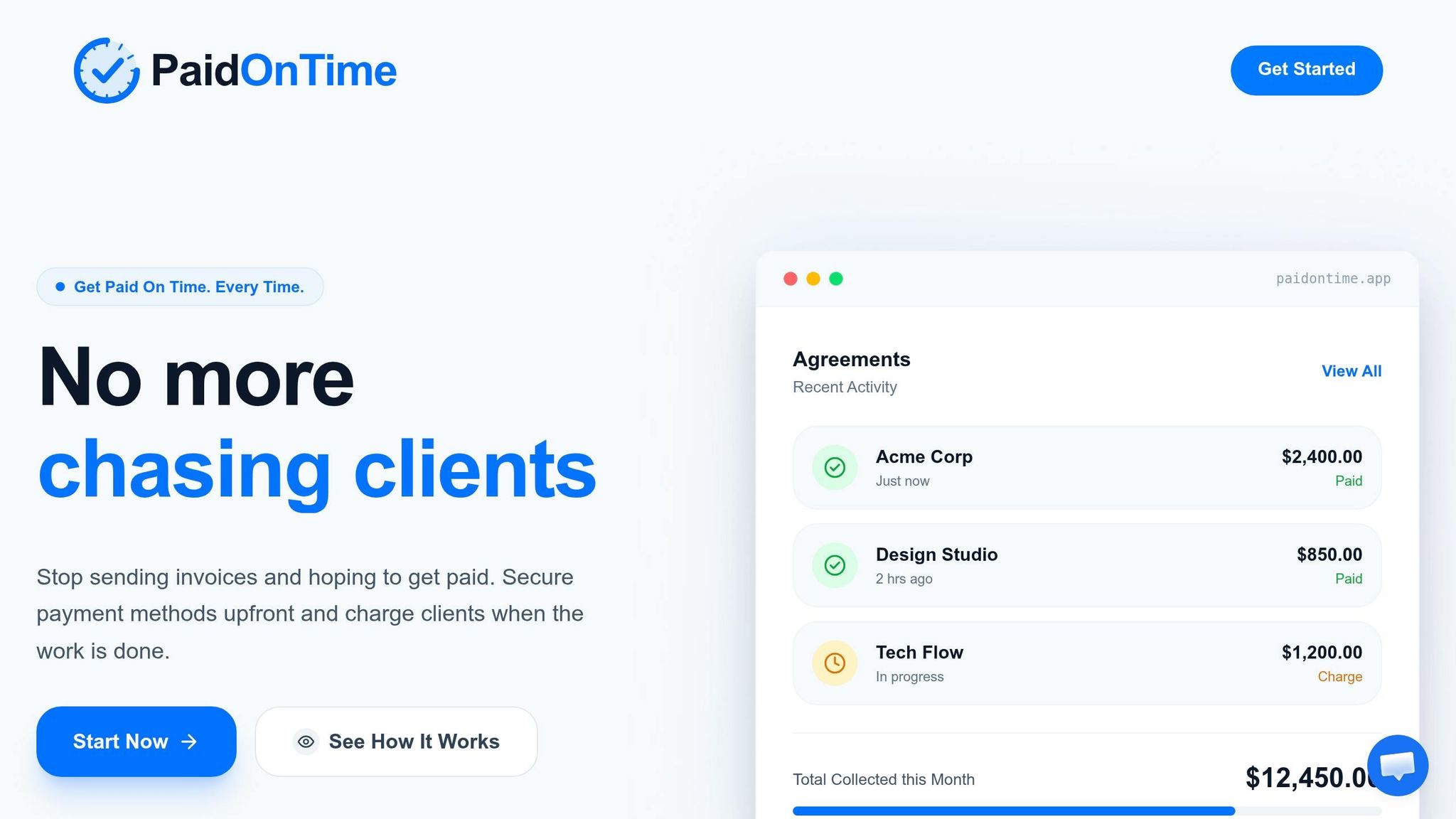
Paid on Time (https://paidontime.app) is a platform designed to protect your earnings by securing funds before you even start working. It allows you to create legally binding agreements with clients and lock in their payment method ahead of time. Once your work is complete, you can charge the client with just one click, skipping the need for manual invoicing. This eliminates the delay between finishing a project and getting paid - often the root of payment disputes. The platform charges a 5% transaction fee per payment, but there are no monthly fees to worry about. While securing funds upfront is key, combining this with clear contract terms provides an extra layer of protection.
Write Clear Contracts with Payment Terms
A well-written contract is your first line of defense. Be sure to include specific payment deadlines, late fees, and interest rates to safeguard your earnings. For example, statutory interest rates vary by state: California allows 10% per year, New York 9%, and Texas 6%. Including these terms makes it easier to enforce penalties if payments are delayed. Additionally, your contract should specify that ownership of your work transfers to the client only after full payment is received. This gives you the leverage to hold back final deliverables until the invoice is settled.
Request Upfront Payments or Milestone Billing
Asking for a 50% deposit before starting work is a common industry standard. It ensures the client is committed and reduces your financial risk. For larger projects, milestone billing - where payments are made at key stages of the project - keeps cash flowing and limits your exposure. If a client pushes back against upfront payments or milestone billing, it’s often a warning sign that they may not be reliable.
Comparing Your Recovery Options
When it comes to recovering unpaid invoices, weighing the pros and cons of different methods is key to finding the best approach. Each option comes with its own costs, time commitments, and likelihood of success, so it’s important to match the method to the size of the debt.
For invoices under $500, starting with a demand letter is often the most economical choice since formal legal actions might cost more than the debt itself. If the debt is between $500 and $10,000, small claims court strikes a good balance between affordability and success rates. For clients who remain unresponsive, debt collection agencies can be effective, but they typically take a hefty cut - usually 25–50% of the recovered amount. Bankruptcy claims, on the other hand, should only be pursued as a last resort if the client has filed for insolvency, as freelancers are usually considered unsecured creditors.
"Legal action is not emotional. It is a cost-benefit decision." - BillerBear Team
Before committing to any recovery method, make sure the client is still in business. Winning a court judgment against a bankrupt or defunct company is essentially a waste of time and money. To help you decide, here’s a quick comparison of the main recovery options:
Comparison Table: Mediation, Small Claims Court, Debt Collection, and Bankruptcy Claims
| Recovery Option | Cost | Time Required | Success Rate | Best For |
|---|---|---|---|---|
| Mediation | Low to Moderate | Days to Weeks | Moderate | Resolving quality disputes while preserving relationships |
| Small Claims Court | $30–$300 filing fee | 4–8 weeks | 60–70% | Freelance debts ranging from $500 to $10,000 |
| Debt Collection | 25–50% commission | Weeks to Months | Moderate | Recovering funds from unresponsive clients |
| Bankruptcy Claims | Low (filing fee only) | Months to Years | Very Low | Clients who are insolvent or have declared bankruptcy |
This table breaks down the key factors for each recovery option, helping you decide which one aligns with your specific situation.
Conclusion
Chasing unpaid invoices doesn't have to mean draining your budget on legal fees. The trick lies in choosing the right approach based on the amount owed and how responsive your client is. A good starting point? Send a formal demand letter via certified mail. This simple step often resolves payment issues without further action. If that doesn't work and the amount falls within your state's small claims court limits, filing there can be an affordable next move.
But here's the thing: avoiding payment issues altogether is even better. Platforms like Paid on Time can make a huge difference by securing payment methods upfront and allowing quick, hassle-free charges. With tools like these, you’ll spend less time chasing payments and more time focusing on your work.
"The strongest freelancers are not the most aggressive. They are the most structured." - BillerBear Team
Having strong contracts is another way to stay ahead of payment problems. Include clear payment terms, late fees, and upfront deposits in your agreements to set a professional tone from the start. And don’t underestimate the importance of keeping detailed records of contracts, invoices, and communications - they can be lifesavers if you need to escalate the issue later.
Finally, remember that pursuing legal action is just business. Weigh the costs and effort of recovery against the amount owed to decide if it's worth it. For smaller debts, the process might not justify the expense. By blending preventive strategies with smart recovery methods, you can stay on top of your freelance payments and keep your earnings secure.
FAQs
When should I stop reminders and send a demand letter?
You should send a demand letter if your client has ignored multiple follow-ups - whether through emails or calls - over a period of 10 to 14 days. Before taking this step, make sure you've kept a record of all your communication attempts and confirmed that the invoice is still unpaid. If the amount owed falls within the limits for small claims court, a demand letter can often resolve the matter without escalating to legal action.
What evidence do I need to win in small claims court?
To do well in small claims court, you need to present clear, well-organized evidence that backs up your claim. Important documents to bring include things like written agreements (these can be formal contracts or even informal ones, such as emails or text messages), invoices, receipts, and proof that the work or service was delivered. Point out specific clauses or communications that strengthen your argument, and make sure everything is neatly organized for quick reference. Having strong, detailed evidence can make a big difference in your case.
How can I prevent nonpayment before I start a project?
To prevent issues with nonpayment, it's crucial to set clear payment terms from the start. Use written agreements to spell out details like payment schedules, deadlines, and any late fees. Tools such as Paid on Time can simplify this process by helping you create agreements, secure payment methods, and even process one-click charges once the work is completed. Make sure to document everything and communicate these terms clearly before beginning any project. This ensures expectations are aligned and safeguards your work.