What Happens When Clients Don't Pay? Your Options

What Happens When Clients Don't Pay? Your Options
Non-payment from clients can disrupt your business and cash flow. Here's what you can do:
- Act Quickly: Recognize warning signs like missed deadlines or poor communication. Address the issue early with polite reminders and organized documentation.
- Use Tools: Automate invoicing and payment processes with platforms that secure payment methods upfront and simplify follow-ups.
- Take Formal Steps: If reminders fail, send a demand letter, hire a collection agency, or file a small claims court case.
- Prevent Future Issues: Require upfront deposits, use clear contracts, and consider milestone-based payment structures.
Key Stats:
- 70% of freelancers face non-payment issues.
- 68% have used savings due to delayed payments.
- Only 84% of invoices are fully paid.
Takeaway: Protect your income with clear systems, proactive measures, and professional tools to minimize risks and recover unpaid invoices efficiently.
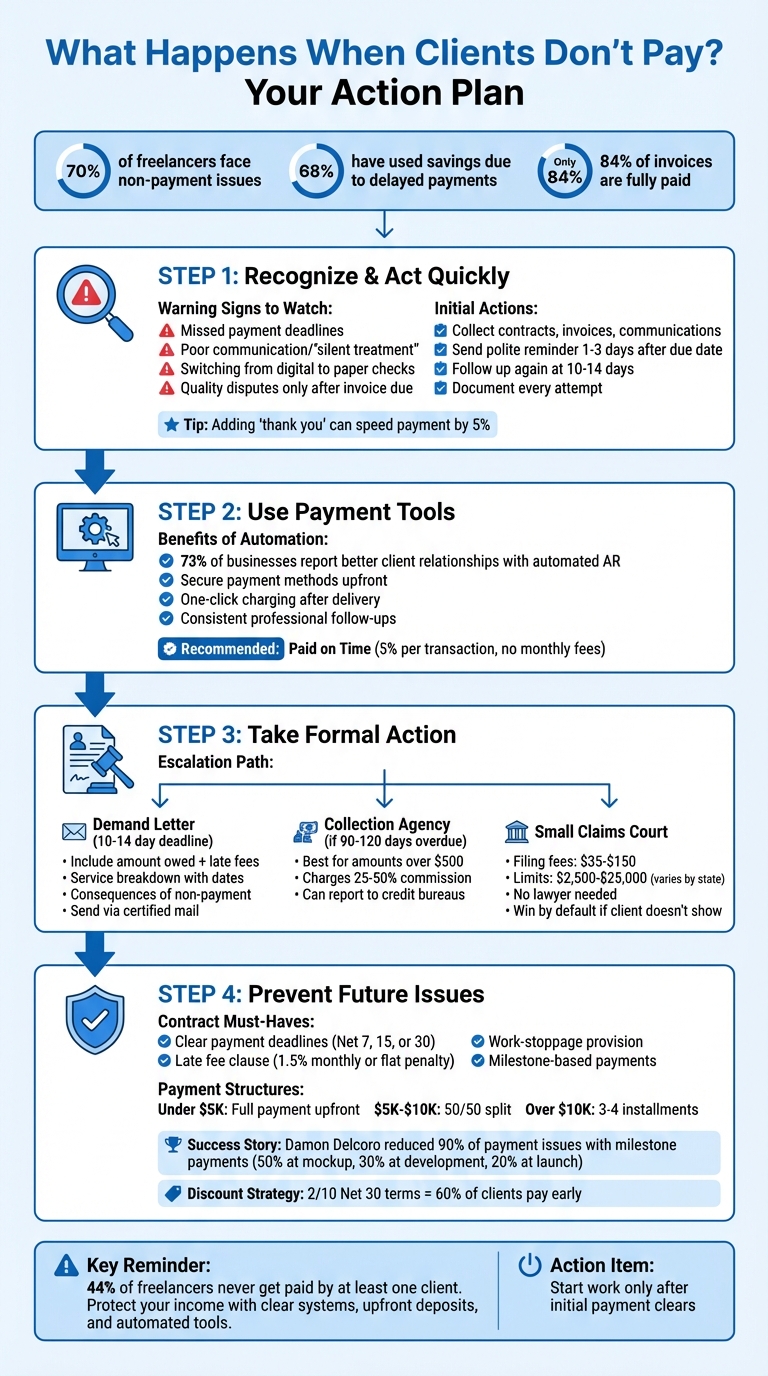
4-Step Process to Handle Non-Paying Clients and Recover Unpaid Invoices
What to Do When Copywriting Clients Don't Pay
sbb-itb-66f4c95
Step 1: Recognize the Problem and Take Initial Action
Think a payment might not come through? Act quickly to protect yourself financially. Start by identifying warning signs, organizing your documentation, and sending polite reminders. Addressing potential issues early can help resolve them while keeping your professional relationships intact.
Warning Signs That Payment May Not Come
Late payments can happen for many reasons - some are innocent mistakes, while others might indicate trouble. Pay close attention to shifts in behavior. For example, if a client known for paying early suddenly waits until the deadline, it could hint at cash flow issues. Another red flag is a lack of communication, like ignoring your messages after receiving an invoice (often called the "silent treatment"). Other signs include switching from digital payments to paper checks, disputing work quality only after the invoice is due, or claiming they can't pay until their own client pays them. Considering only about 84% of invoices are fully paid, recognizing these patterns early can help you decide whether to pause work or get clients to pay on time using proven methods.
Collect Your Contracts, Invoices, and Communications
Before contacting the client about the overdue payment, gather all your paperwork. Start with your signed contract that spells out payment terms. Double-check your invoices to ensure they include unique numbers, clear due dates, and itemized services. Also, organize all client communications - emails, texts, call notes - and any proof that your services were delivered as agreed. This "paper trail" is essential if you need to escalate the situation to a collection agency or small claims court. Keeping these records in order not only strengthens your case but also makes future payment recovery efforts smoother. Tools that provide read receipts can confirm your invoice was received.
Send Professional Payment Reminders
Assume the delay is accidental, like a misplaced email or a bank processing delay. Send a friendly reminder 1–3 days after the due date. Include all key details: the invoice number, the amount owed, the original due date, and a direct link for payment. Using polite language such as "please" and "thank you" can speed up payment by 5%, and adding a "thank you" in the terms might help even more.
If there’s no response within a week, follow up again around day 10–14, either by phone or by reaching out to accounts payable. Document every attempt - note the dates, methods, and any replies - as this record could be crucial if you need to escalate. For instance, in May 2025, Tom successfully resolved a $6,500 overdue invoice after sending a polite email 10 days past the due date. The client explained a bank error and paid the next day, preserving their working relationship for future referrals.
"Chasing unpaid invoices is never enjoyable, but it's a crucial business skill every freelancer must develop. The key is knowing how to follow up professionally while maintaining your boundaries and protecting your cash flow." – Cassidy Rush, Writer, Remitly
If the client is genuinely struggling financially, consider offering a payment plan - like 50% now and 50% in 30 days - to increase the likelihood of recovery. Once you’ve sent your reminders and have your documentation ready, you’ll be prepared to explore additional recovery options if the issue persists.
Step 2: Use Payment Tools to Recover What You're Owed
After taking the first steps, manual invoicing can become a major time sink. Modern payment platforms, on the other hand, streamline the process and help you maintain a professional image.
How Paid on Time Secures Your Payments
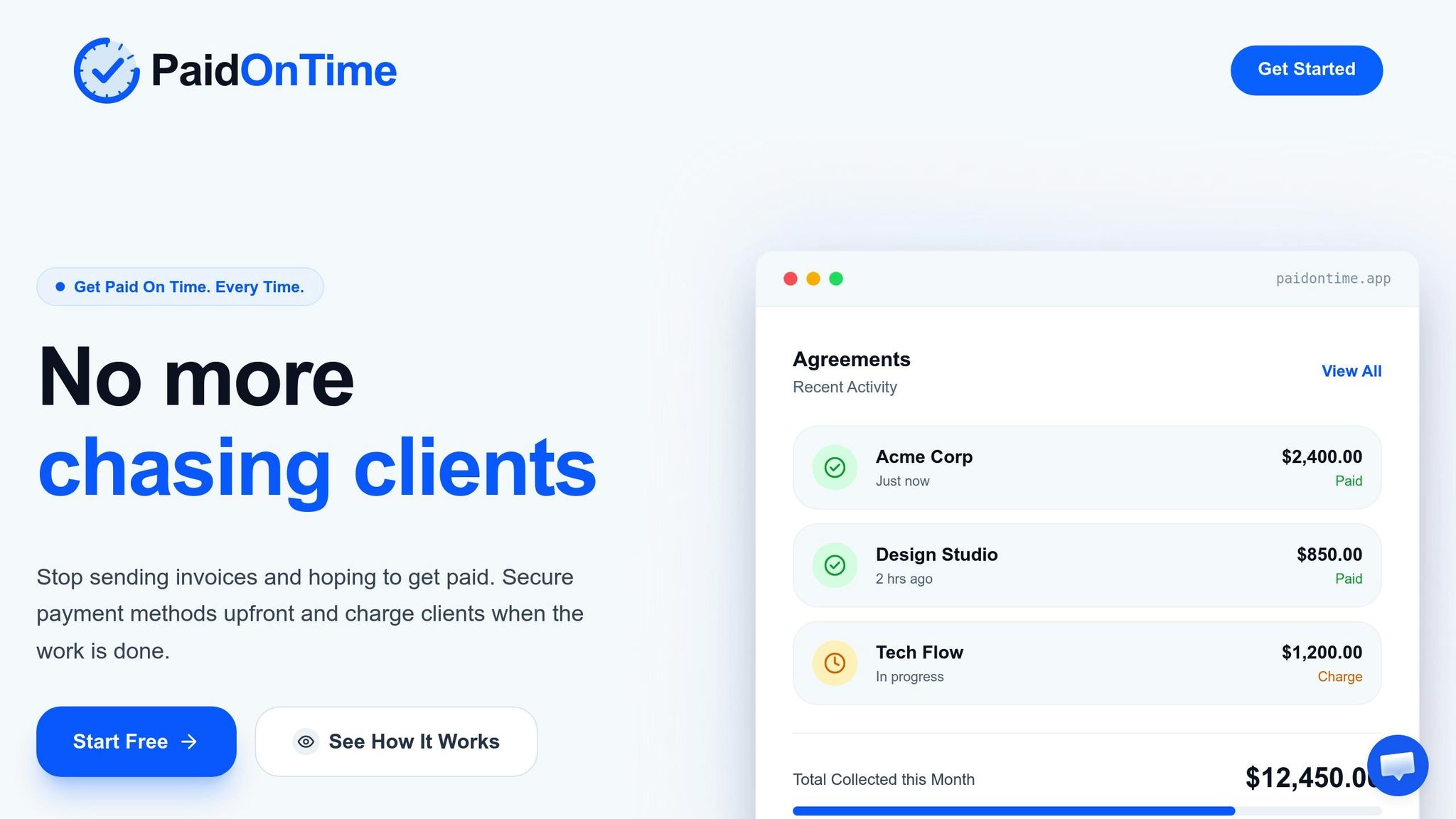
Paid on Time simplifies the payment process by setting up a legally binding agreement before you even begin the work. It also secures the client’s payment method upfront. Once the job is done, you can charge their stored payment method with a single click - no more waiting for checks or chasing down credit card details. This eliminates the common delays caused by missing information, which are all too common with traditional invoicing. Plus, it gives you an advantage if any payment disputes arise.
The platform also keeps detailed payment records and receipts for both you and your client. This transparency reduces confusion and makes resolving disputes much easier. When clients know their payment method is securely stored and charges will be processed automatically after delivery, they’re more likely to voice concerns early rather than going quiet after the work is done.
With this secure setup in place, automated systems can take things further by simplifying follow-ups and improving client relationships.
Why Automated Payment Systems Are More Effective
Automation takes the stress out of chasing payments, creating a smoother experience for everyone involved. In fact, 73% of businesses report better client relationships after adopting automated accounts receivable processes.
These systems ensure every client receives consistent and professional follow-ups, which reinforces the importance of timely payments. They also address the hesitation many business owners feel - 33% admit they’re reluctant to pursue overdue payments. Interestingly, research from the UK Department for Business & Trade found that following up on payments can actually strengthen customer relationships rather than harm them. By letting the system handle these tasks, you can focus on delivering quality work while keeping your cash flow steady.
Step 3: Take Formal Action When Needed
If reminders and automation haven’t worked, it’s time to take formal steps to secure payment. These measures are more structured and can help you recover what’s owed when informal efforts fail.
Write and Send a Demand Letter
A demand letter is often the first official step in pursuing unpaid invoices. It outlines the amount owed, sets a final payment deadline (usually 10–14 days), and explains what will happen if payment isn’t made. In some states, this step is required before filing a small claims case.
Your letter should include:
- The total amount owed, including any late fees
- A detailed breakdown of services provided with dates
- A clear payment deadline
- Consequences of non-payment
Attach copies of relevant documents, such as your contract, invoices, and proof of completed work.
"A demand letter - or debt collection letter - is the first step in collecting a debt that is owed to you." – Brette Sember, J.D.
Send the letter via certified mail with a return receipt requested. This ensures you have proof the client received it, which can be crucial if the case goes to court. For larger amounts, you might want an attorney to draft or co-sign the letter to show that you’re serious about legal action. Be aware of deadlines - California, for example, has a four-year statute of limitations for written contracts and two years for oral agreements.
If the demand letter doesn’t resolve the issue, your next options include hiring a collection agency or pursuing legal action.
When to Hire a Collection Agency
A collection agency can step in when your internal efforts have failed and the invoice is 90 to 120 days past due. This option is usually worth considering for amounts over $500, where the potential recovery outweighs the agency’s commission.
Before proceeding, ensure you have complete documentation. Collection agencies typically work on a contingency basis, charging 25% to 50% of the amount they recover. They bring expertise to the table and can report delinquent accounts to credit bureaus, which adds pressure on the debtor. Always verify that the agency complies with the Fair Debt Collection Practices Act and is accredited by the Better Business Bureau.
"Sending a client to collections means you're hiring a third-party debt collection agency to recover unpaid invoices on your behalf." – Preston Lee, Founder, SolidGigs
Keep in mind that involving a collection agency often ends your relationship with the client, and there’s no guarantee you’ll recover the full amount owed.
File a Small Claims Court Case
Small claims court is an option for straightforward cases where you don’t need a lawyer. It’s a step to consider after other recovery methods have been exhausted. Filing fees typically range from $35 to $150, depending on your state. Monetary limits also vary - usually between $2,500 and $25,000 - so check your local court’s rules before filing.
To begin, get a complaint form from your local court clerk or website. File the form, pay the fee, and notify the defendant formally - this can be done through a process server, sheriff, or certified mail (but never deliver the papers yourself). Prepare three copies of all evidence for the judge, the defendant, and your own records.
"If you file a suit in small claims court and your client doesn't show up to dispute it, you'll win by default." – Amanda Hayes, Attorney
Even if you win the case, payment isn’t always immediate. If the client still doesn’t pay, you may need to take further legal steps like wage garnishment, bank levies, or placing a lien on their property.
Step 4: Stop Non-Payment Before It Happens
After taking steps to recover unpaid invoices, it’s equally important to prevent non-payment from happening again. Research from 2025 shows that 85% of freelancers experienced late payments at least occasionally, and 21% dealt with late or missed payments more than half the time. Building proactive systems into your workflow from the start can safeguard your cash flow and minimize payment disputes.
Write Contracts with Clear Payment Terms
A well-crafted contract not only protects your income but also helps maintain strong client relationships. Be explicit about payment deadlines, late payment penalties, and your rights if a client fails to pay. For instance, include a "Net" payment period - such as Net 7, Net 15, or Net 30 - to set clear expectations. Adding a late fee clause, like a 1.5% monthly interest charge or a flat penalty, can serve as a deterrent for delayed payments.
Breaking your total fee into milestone-based payments tied to specific deliverables is another smart move. Damon Delcoro, Founder of UltraWeb Marketing, implemented this approach for web design projects: 50% at mockup approval, 30% upon completing development, and 20% at launch. This system, along with transitioning SEO clients to quarterly retainers paid upfront, reduced 90% of the firm’s payment collection issues.
"The biggest shift was implementing milestone-based payments tied to specific deliverables... Clients can't move forward without paying for the previous phase, which naturally creates payment urgency without awkward conversations." – Damon Delcoro, Founder, UltraWeb Marketing
You might also consider offering early payment discounts, such as "2/10 Net 30" terms, where clients receive a 2% discount for paying within 10 days, with the full amount due in 30 days. Stephanie Allen, CEO of AirWorks Solutions, adopted this method in 2025. Along with requiring a 50% deposit for HVAC installations, she found that 60% of clients paid early, which improved her company’s cash flow.
Another important clause to include is a work-stoppage provision, stating that all services will pause, and deliverables will be withheld if payments are overdue. This gives you leverage without requiring uncomfortable discussions about halting work.
Require Upfront or Partial Payment
Collecting an upfront deposit ensures client commitment and covers initial project costs. Over 70% of freelancers have faced non-payment issues during their careers, and requiring deposits is one of the most effective ways to screen out unreliable clients.
A client’s willingness to pay upfront can reveal their commitment and financial stability. Those who hesitate or make excuses may lack the funds to see the project through - or worse, might plan to dispute payments later. Here are some suggested payment structures to maintain steady cash flow:
- Small projects under $5,000: Request full payment upfront.
- Mid-range projects ($5,000–$10,000): Split payments 50/50 - half upfront and half upon completion.
- Large projects over $10,000: Break payments into three or four installments.
"Unless you're dealing with a large company with a long track record, there's something wrong if a client won't pay anything upfront." – Millo
Always start work only after the initial payment clears. If a client is hesitant to pay directly, suggest using an escrow service. This way, a third party holds the funds until milestones are met, providing security for both sides.
Set Up Paid on Time for Consistent Payment Security
Automating your payment process can ensure timely payments and protect your cash flow from the outset. Paid on Time streamlines the invoicing process, eliminating manual delays that often lead to late payments.
Stephanie Allen, CEO of AirWorks Solutions, highlighted the importance of immediate invoicing: "My biggest mistake was not invoicing immediately upon job completion. I used to batch invoices weekly... Now our technicians send invoices from the field using mobile apps - payment requests go out within hours, not days."
At a rate of just 5% per transaction with no monthly fees, Paid on Time is a practical solution for freelancers and small businesses. You only pay when you get paid, making it a cost-effective way to secure your income while avoiding cash flow disruptions.
Conclusion: Protect Your Business from Non-Payment
Non-payment can seriously disrupt your business. In fact, 44% of freelancers report not being paid at all by a client, and 68% have had to dip into savings due to delayed payments. Taking steps to secure your payments from the beginning is essential for maintaining steady cash flow.
Start by using solid contracts, requesting upfront deposits, and relying on automated invoicing systems. Researching new clients is equally important - check their online reviews and reputation for any warning signs. For clients you're unsure about, begin with smaller projects, ideally around $500 or less, to gauge their reliability.
When payment issues arise, having a plan makes all the difference. Send reminders within 1–3 days of a missed payment, and if that doesn’t work, escalate to a formal demand letter. If unpaid after 14 days, pause your work. Legal action is also an option - filing fees for small claims court are often under $100.
Automation tools like Paid on Time can also streamline the process. With no monthly fees and a 5% transaction cost, it’s a straightforward way to secure payments and avoid time-consuming invoice follow-ups.
At the end of the day, protecting your payments is about valuing your time and expertise. By prioritizing payment security, you’re not just safeguarding your income - you’re reinforcing the worth of your work.
FAQs
When should I stop work if a client is overdue?
If a client falls behind on their payment, it’s best to stop working immediately. This approach not only protects your time but also reinforces the importance of sticking to agreed payment terms. If sending reminders doesn’t resolve the issue, you might need to take stronger measures - like withholding access to completed work or pausing any ongoing tasks until the overdue invoice is paid. These actions can often prompt faster payment while ensuring your efforts aren’t undervalued.
What should I include in a demand letter?
When drafting a demand letter for payment, it’s important to be both professional and clear. Here's what to include:
- State the debt clearly: Specify the exact amount owed and outline the goods or services provided.
- Include invoice details: Reference the invoice number, issue date, and original due date for easy tracking.
- Request payment firmly but politely: Acknowledge the overdue status and request immediate payment without sounding overly harsh.
- Attach supporting documents: Provide relevant materials like signed contracts, receipts, or any agreements to back up your claim.
This approach ensures your letter is straightforward, professional, and effective.
How do I prove a client owes me money?
To show that a client owes you money, it's crucial to keep detailed documentation that clearly establishes the debt. Start with a signed contract that outlines the payment terms, the agreed-upon amount, and the scope of work you completed. Additionally, save records of all relevant communications, including emails, messages, or any correspondence discussing payments. Don't forget to keep copies of all invoices you’ve sent. These documents can act as solid evidence if you're forced to take legal action or involve a collections agency.