Top 5 Secure Payment Methods for Freelancers

Top 5 Secure Payment Methods for Freelancers
Freelancers face significant challenges with late payments - affecting 75% annually - and high transaction fees, especially for international work. Choosing the right payment method can protect your income, reduce costs, and streamline your workflow. Here are five secure options:
- Paid on Time: Charges clients upfront and ensures steady cash flow with a 5% transaction fee. Tailored for U.S. freelancers with USD-only transfers.
- PayPal: Widely used, offering fraud monitoring and seller protection. Fees range from 2.9% to 4.4% plus fixed charges; international transfers can be costly.
- Stripe: Developer-friendly with robust security. Domestic fees are 2.9% + $0.30; international fees add 1.5% plus 1% for currency conversion.
- Wise: Ideal for international payments, using mid-market exchange rates with fees starting at 0.57%. Supports over 40 currencies.
- Payoneer: Strong for global clients, integrating with platforms like Upwork. ACH transfers cost 1%, and annual fees apply for low-volume users.
Quick Comparison:
| Payment Method | Best For | Transaction Fees | Key Features |
|---|---|---|---|
| Paid on Time | U.S. freelancers | 5% | Upfront deposits, milestone payments |
| PayPal | Domestic transactions | 2.9%-4.4% + fixed fee | Fraud monitoring, seller protection |
| Stripe | Domestic and global | 2.9% + $0.30 (domestic); +1.5% (intl) | AI fraud detection, automation tools |
| Wise | International payments | Starting at 0.57% | Mid-market rates, multi-currency accounts |
| Payoneer | Global freelancers | 1% ACH; $29.95 annual fee (low volume) | Multi-currency Mastercard, integrations |
Each method offers specific benefits depending on your needs, whether it's reducing fees, handling international clients, or improving payment security.
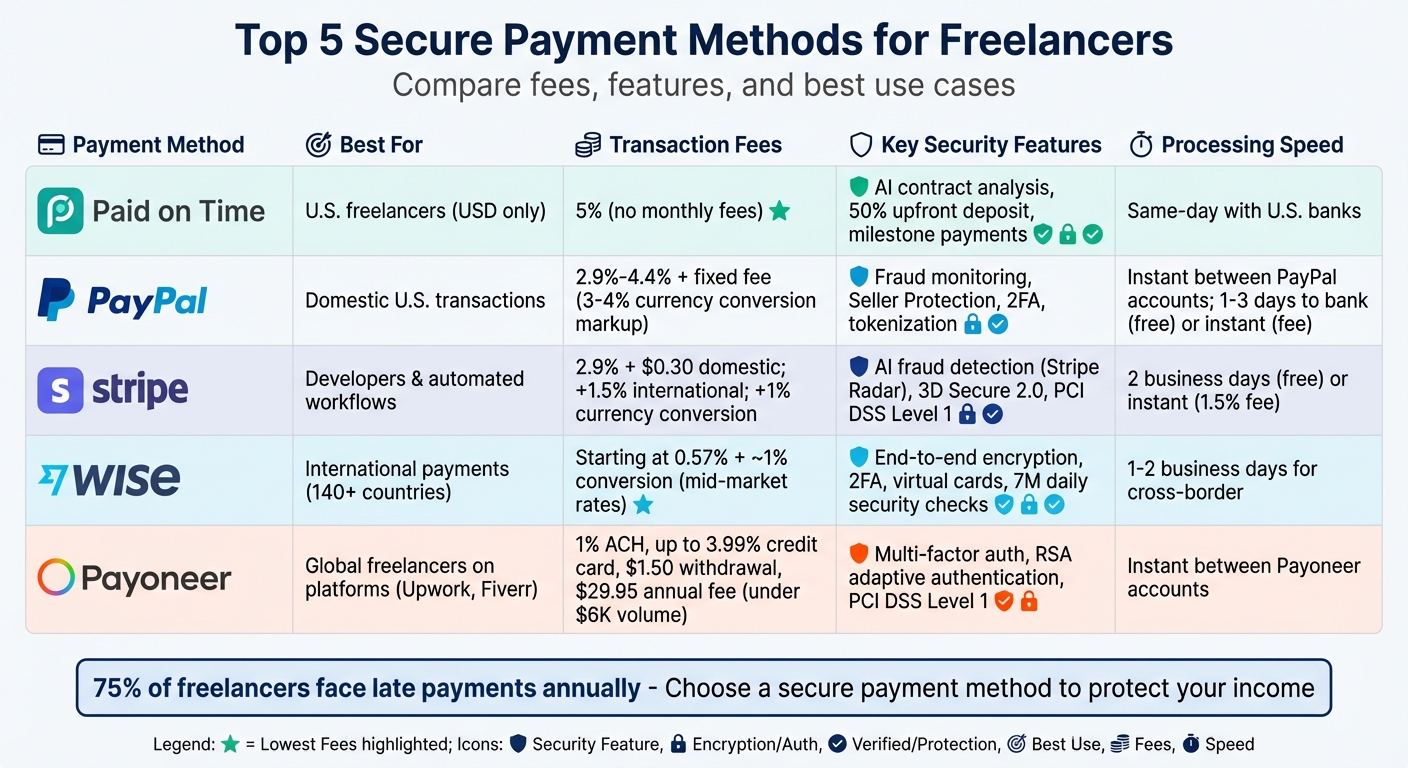
Comparison of 5 Secure Payment Methods for Freelancers: Fees and Features
Best Alternatives to PayPal for International Freelancers (Best Way to Get Paid Internationally)
sbb-itb-66f4c95
1. Paid on Time
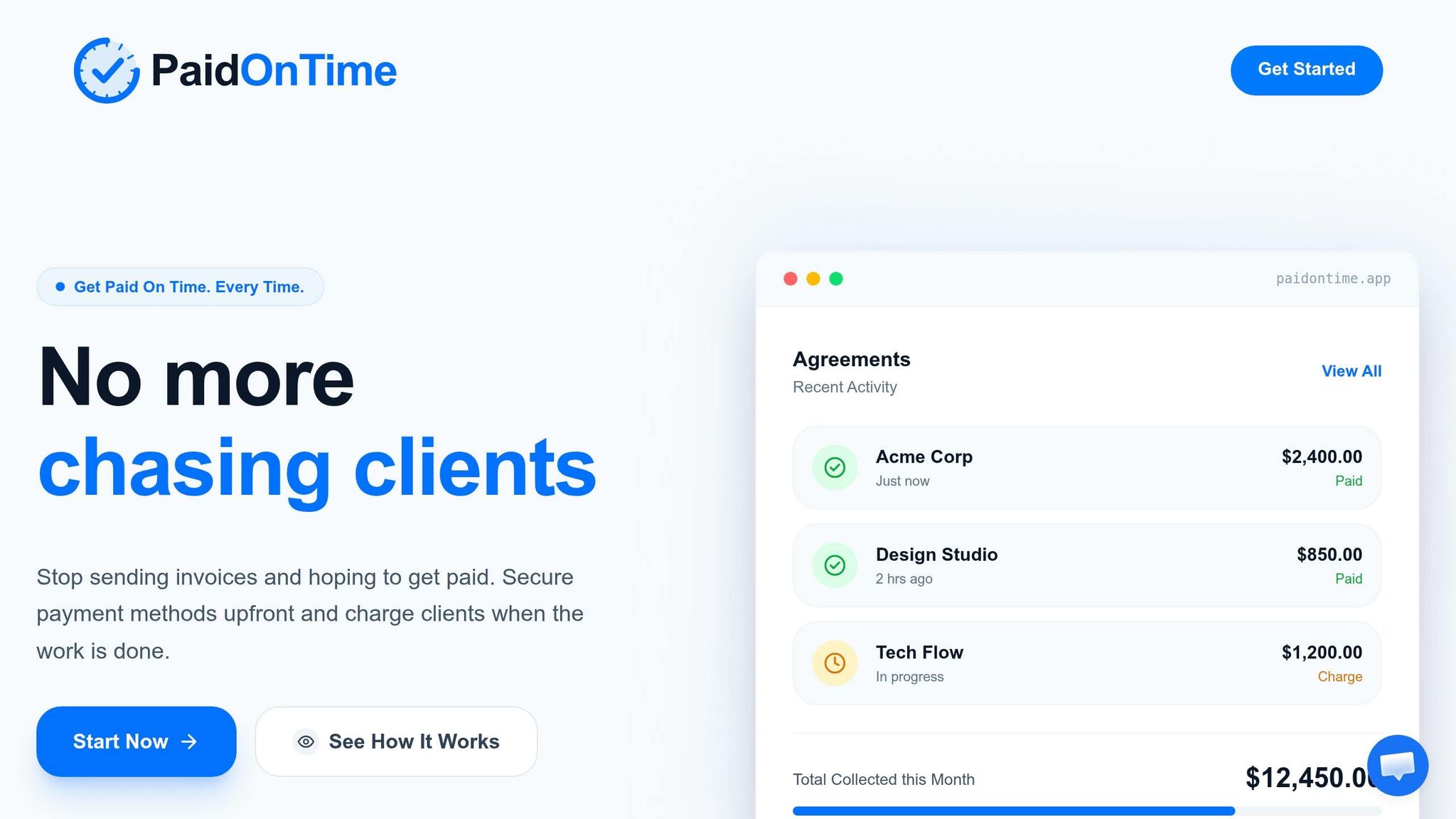
Paid on Time tackles the common issue of delayed payments by requiring payment details before any work begins. Instead of waiting for invoices to be processed after delivering your work, this system allows you to charge clients with a single click once the job is done. This proactive approach helps freelancers maintain steady cash flow throughout their projects.
Security Features
Paid on Time prioritizes security right from the start. The platform uses AI-driven contract analysis to review agreements for risky payment terms and ensure their legal validity. It also requires a 50% upfront deposit, which helps weed out less-serious clients and minimizes financial risk at the beginning of a project. For longer assignments, milestone-based payments tied to specific deliverables provide an effective way to manage payment risks.
Transaction Fees and Pricing Structure
The platform operates on a straightforward pricing model: a 5% transaction fee with no monthly subscription charges. You only pay when you get paid, keeping costs easy to predict.
Ease of Integration with Freelance Workflows
Paid on Time simplifies the payment process by setting clear expectations during the quoting phase, which is particularly helpful for new or international clients. Invoices are sent alongside project files, eliminating the need for separate billing days and speeding up payment processing. This streamlined system reduces administrative burdens, allowing freelancers to focus more on their work.
Suitability for US Freelancers
Paid on Time is tailored specifically for freelancers in the U.S., operating exclusively in USD. This removes the potential for unexpected currency conversion fees. Its integration with U.S. banking systems ensures quick and hassle-free transfers, making payments smooth and efficient.
2. PayPal
PayPal stands out as a popular payment option in the U.S., with 59% of freelancers naming it their preferred method. Its widespread use means most clients are already familiar with the platform. Let’s take a closer look at the features that make PayPal a reliable choice for freelancers in the U.S.
Security Features
PayPal prioritizes secure transactions by using TLS and SSL protocols to encrypt all data during transmission. It also employs 24/7 fraud monitoring powered by advanced AI analytics to identify and flag suspicious activity in real time. For freelancers, the Seller Protection program is a key benefit, covering eligible transactions against claims like "Unauthorized Transaction" and "Item Not Received". To further minimize risks, PayPal uses tokenization, which replaces sensitive payment details with unique identifiers during recurring transactions. Enabling two-factor authentication (2FA) adds an extra layer of account security.
Transaction Fees and Pricing Structure
PayPal’s fees are straightforward but can add up, especially for international payments. Domestic transactions within the U.S. are charged 2.9% plus a fixed fee, while international payments come with a higher charge of about 4.4% plus a fixed fee. Currency conversion fees are another consideration, as PayPal applies a markup of 3% to 4% above mid-market exchange rates. For instance, freelancers earning $5,000 monthly from international clients could face nearly $5,000 in yearly fees. Transfers to a bank account are free if processed within 1–3 business days, but instant transfers to a debit card or bank account come with an added fee.
Ease of Integration with Freelance Workflows
PayPal’s versatility makes it easy to incorporate into freelance work. The platform includes a built-in invoicing system that lets freelancers track when invoices are viewed, simplifying follow-ups. It also integrates seamlessly with popular invoicing tools like Zoho and Fueler, as well as most e-commerce platforms.
"PayPal is the most widely used payment platform for freelancers in the US. It's accepted by almost every client, offers instant transfers between PayPal accounts, and makes invoicing simple."
- Riten Debnath, Founder of Fueler
The mobile app further enhances convenience, enabling users to manage transactions and send invoices from anywhere.
Suitability for US Freelancers
PayPal is particularly well-suited for domestic freelance work in the U.S. Transfers between PayPal accounts are instant, and same-day bank transfers are available for a small fee. Additionally, the platform simplifies tax reporting by issuing a Form 1099-K once total payments reach $600. However, freelancers should account for transaction fees ranging from 3% to 8% when pricing their services. It’s also worth noting that funds may be frozen for 30–90 days during disputes or when unusual activity is detected.
3. Stripe
Stripe is widely regarded as a platform that prioritizes developers and offers robust security features, making it a go-to option for freelancers. As a PCI DSS Level 1 Service Provider, it ensures client data is safeguarded to the highest industry standards.
Security Features
Stripe employs advanced security protocols to protect transactions. It uses Transport Layer Security (TLS) to encrypt data during transmission and tokenization to replace sensitive card information with unique tokens. Additionally, Stripe Radar, an AI-driven fraud detection tool trained on billions of data points, works in real time to detect and block fraudulent transactions. This is especially critical, given that 79% of organizations are projected to face payment fraud in 2024.
"Stripe payment security sets the gold standard."
- MassInvoices
The platform also supports 3D Secure 2.0 authentication, an extra layer of verification for online purchases. For disputes, Stripe provides detailed chargeback management tools, applying a $15 fee only if the dispute is lost.
Transaction Fees and Pricing Structure
Stripe uses a straightforward pay-as-you-go pricing model with no setup or monthly fees. Here’s a quick breakdown of costs:
- Domestic card transactions: 2.9% + 30¢ per successful charge
- International cards: Additional 1.5% fee
- Currency conversion: 1% fee when applicable
- ACH Direct Debit: 0.8% per transaction (capped at $5.00)
For freelancers using Stripe’s invoicing system, there’s a 0.4% fee per paid invoice (capped at $2.00). Instant payouts to your bank account cost 1.5% (minimum 50¢), while transfers taking two business days are free.
Ease of Integration with Freelance Workflows
Stripe offers flexible options for freelancers to collect payments, whether or not they have technical skills. For those without a website, Payment Links provide a secure way to share payment requests directly with clients. Freelancers with websites can use Stripe Checkout, a prebuilt payment page that integrates seamlessly.
The platform also includes Stripe Workflows, a no-code tool that automates tasks like flagging high-value transactions or retrying failed payments. This feature helps recover an average of 57% of failed recurring payments.
Stripe further integrates with popular tools like QuickBooks and Salesforce, helping freelancers streamline their financial management. Payments typically reach US bank accounts within two business days, ensuring reliable cash flow. These features make Stripe a dependable option for domestic transactions and automated workflows.
Suitability for US Freelancers
Stripe is particularly well-suited for US freelancers working in dollars. It supports key domestic systems like ACH Direct Debit and FedNow, which enables instant, round-the-clock payments. Another helpful feature is the Card Account Updater, which automatically updates expiring client card details to avoid disruptions in payments.
"Stripe is perfect for US freelancers who want to accept card payments, automate their billing, and impress clients with professional invoices."
- Riten Debnath, Founder, Fueler
While Stripe supports over 135 currencies, US freelancers often benefit the most from domestic transactions due to lower fees and faster settlements. When working with international clients, freelancers should account for fees that can exceed 4.4%, ensuring these costs are factored into their project pricing.
4. Wise

When it comes to managing cross-border payments, Wise proves to be a strong choice for freelancers in the US. With its transparent pricing and emphasis on security, Wise caters to those working with international clients. Impressively, the platform conducts over 7 million daily security checks to guard against unauthorized access and fraud.
Security Features
Wise takes security seriously by employing several protective measures. It uses end-to-end encryption to ensure sensitive data stays secure during transmission, making it unreadable to anyone without proper authorization. On top of that, tokenization replaces actual card details with unique identifiers, adding another layer of protection. The platform also supports two-factor authentication (2FA), requiring a mobile verification code for extra security.
For additional peace of mind, Wise offers virtual cards that can be frozen immediately after use. Funds are safeguarded within a diversified portfolio of trusted financial institutions, and Wise operates under the regulation of financial authorities in every country it serves.
Transaction Fees and Pricing Structure
Wise stands out for its straightforward and transparent pricing. It uses the mid-market exchange rate - the same rate you’d find on Google - without hidden markups. For US-based freelancers, there are no monthly fees or minimum balance requirements.
Here’s a quick breakdown of the fees:
- Transfer fees start at 0.57% per transaction.
- Currency conversion fees hover around 1%.
- A one-time fee applies if you need local account details in major currencies.
"Wise uses the mid-market exchange rate (the one you'll see on Google) for all currency conversions. You see the exact fee upfront, with no hidden charges." - Wise
Ease of Integration with Freelance Workflows
Wise Business is designed to fit seamlessly into freelance workflows. It integrates with popular accounting tools like QuickBooks, Xero, Sage, and FreshBooks, simplifying financial management. The platform’s BatchTransfer tool allows you to pay up to 1,000 recipients simultaneously, saving time on bulk payments.
Freelancers can also take advantage of Wise's free invoicing tool for professional billing. Additionally, you can set a preferred exchange rate, and Wise will automatically execute the transfer once that rate is reached.
Suitability for US Freelancers
For US freelancers, Wise makes receiving international payments as straightforward as domestic ones. The platform provides local bank details, including routing and account numbers, for easy transactions.
Here’s what you can expect:
- Manage funds in over 40 currencies.
- Send money to more than 140 countries.
- Cross-border payments typically settle within 1–2 business days.
Wise has earned a 4.3/5 star rating on Trustpilot from over 230,000 reviews. Users often highlight its transparent fee structure and quick international transfers. Whether you’re handling occasional overseas payments or managing regular international transactions, Wise offers a reliable and efficient solution.
5. Payoneer
Payoneer is a popular choice among freelancers working with international clients. It stands out for its ability to handle cross-border payments efficiently while offering reasonable fees, particularly for freelancers based in the United States. If you're using platforms like Upwork or Fiverr, you'll appreciate its seamless integration with these marketplaces.
Security Features
Payoneer prioritizes security with multi-factor authentication options, including SMS, calls, authenticator apps, and push notifications. Each transaction undergoes evaluation using RSA adaptive authentication, taking into account factors like location, IP address, and transaction amount.
Fraud prevention is another key focus. Payoneer employs real-time transaction monitoring, web application firewalls (WAF), bot detection, and duplicate site activity monitoring to safeguard accounts. The platform also boasts PCI DSS Level 1 certification and has completed rigorous SOC 1 Type II and SOC 2 Type II assessments, meeting top industry compliance standards.
Transaction Fees and Pricing Structure
For US freelancers, Payoneer offers a transparent and competitive fee structure. Payments received via ACH bank debit come with a 1% fee, while credit card payments are charged up to 3.99%. Withdrawing funds to a local USD bank account costs a flat $1.50 per transaction for monthly volumes under $50,000.
However, Payoneer charges an annual account fee of $29.95 if your account receives less than $6,000 within a 12-month period. This makes it less appealing for occasional freelancers. On the plus side, transfers between Payoneer accounts are free and processed instantly.
Beyond these fees, Payoneer simplifies financial management for freelancers, offering tools that save time and improve efficiency.
Ease of Integration with Freelance Workflows
Payoneer integrates seamlessly with major freelance platforms like Upwork, Fiverr, eBay, and Etsy, as well as accounting tools such as Zoho Books. Its "Request a Payment" feature allows freelancers to send professional payment links directly to clients via email, eliminating the need for complicated invoicing systems. For those managing multiple clients, the batch payment feature streamlines the process by letting you request up to 200 payments at once using reusable file templates.
The platform’s REST API and webhooks take automation a step further, enabling real-time notifications for invoicing, currency conversion, and payment tracking. You can easily monitor all activity through the dashboard’s "Timeline" and "Details" tabs, which provide real-time updates on every payment request.
These features make Payoneer a practical tool for freelancers juggling multiple clients and projects.
Suitability for US Freelancers
With its strong security measures and integrations, Payoneer is well-suited for US freelancers. The platform offers local receiving accounts with US routing and account numbers, allowing international payments to be processed as domestic ACH transfers. This eliminates costly wire transfer fees, which can range from $15 to $50 per transaction. Additionally, Payoneer supports withdrawals to bank accounts in over 190 countries and in more than 70 currencies.
"What I love about Payoneer is the freedom I have to use it all over the world and the solution that fits my digital nomad lifestyle." - Eliana Barrionuevo, Freelance Writer & Travel Blogger
Freelancers in the US should communicate upfront with clients about transaction fees to avoid confusion over who will cover these costs. Payoneer’s multi-currency Mastercard offers added flexibility, providing direct access to funds for business expenses or ATM withdrawals.
Payoneer combines robust security with user-friendly features, making it a reliable option for managing both domestic and international payments.
Conclusion
Freelancers have a variety of payment options, each offering specific security measures and cost advantages suited to their needs. Protecting your income is crucial, especially when late payments affect 75% of freelancers annually, with 42% even struggling to pay personal bills as a result. Choosing the right payment system can make a significant difference in ensuring financial stability.
Security features like two-factor authentication, encryption, and fraud monitoring help safeguard your earnings. However, hidden fees and currency conversion markups - ranging from 3% to 10% - can erode your income. To avoid surprises, it’s essential to break down all costs, including transaction fees, withdrawal charges, and exchange rate differences.
Your choice should align with your workflow. For international projects, platforms offering multi-currency accounts or local receiving options can help you avoid wire transfer fees, which can range from $15 to $50 per transaction. For domestic work, ACH transfers are often more affordable and secure. Factors like client location, transaction speed, compatibility with your tools, and billing structure should guide your decision to ensure a steady cash flow.
Diversifying payment methods can help you balance speed, cost, and reliability while minimizing risks associated with relying on a single platform. Implement multi-factor authentication on all accounts, use detailed contracts that outline payment terms, and consider milestone-based payments for larger projects to maintain consistent income.
As freelancing grows, with 86.5 million Americans expected to join the workforce by 2027, selecting a secure payment method is critical. It supports your professional reputation, ensures tax compliance, and provides peace of mind for managing your finances effectively.
FAQs
Which payment method is best for international clients?
When working with international clients, choosing the right payment method can save time and money. Traditional options like bank wire transfers and PayPal often come with steep fees and less-than-ideal exchange rates, making them less appealing for cross-border transactions.
Better alternatives include platforms like Wise and Stripe. These services stand out for their lower fees, competitive exchange rates, and faster processing times. They also prioritize security and reliability, making them excellent choices for handling international payments efficiently.
How can I reduce currency conversion and transfer fees?
To cut down on currency conversion and transfer fees, opt for payment options like ACH transfers or platforms that allow you to maintain accounts in local currencies, reducing or eliminating conversion costs. You can also use services that offer automated currency exchange at competitive rates, making the process smoother while keeping fees low.
What should I do to prevent chargebacks and payment disputes?
To minimize chargebacks and disputes, opt for secure payment methods that include built-in protection and dispute resolution tools. Setting clear, upfront agreements with clients and securing payments before starting work - like leveraging platforms that allow one-click charges - can significantly lower risks. Additionally, using trusted payment gateways with features such as encryption, real-time notifications, and buyer/seller protection ensures transparency and keeps transactions safe.