Checklist for Tax-Compliant Invoices
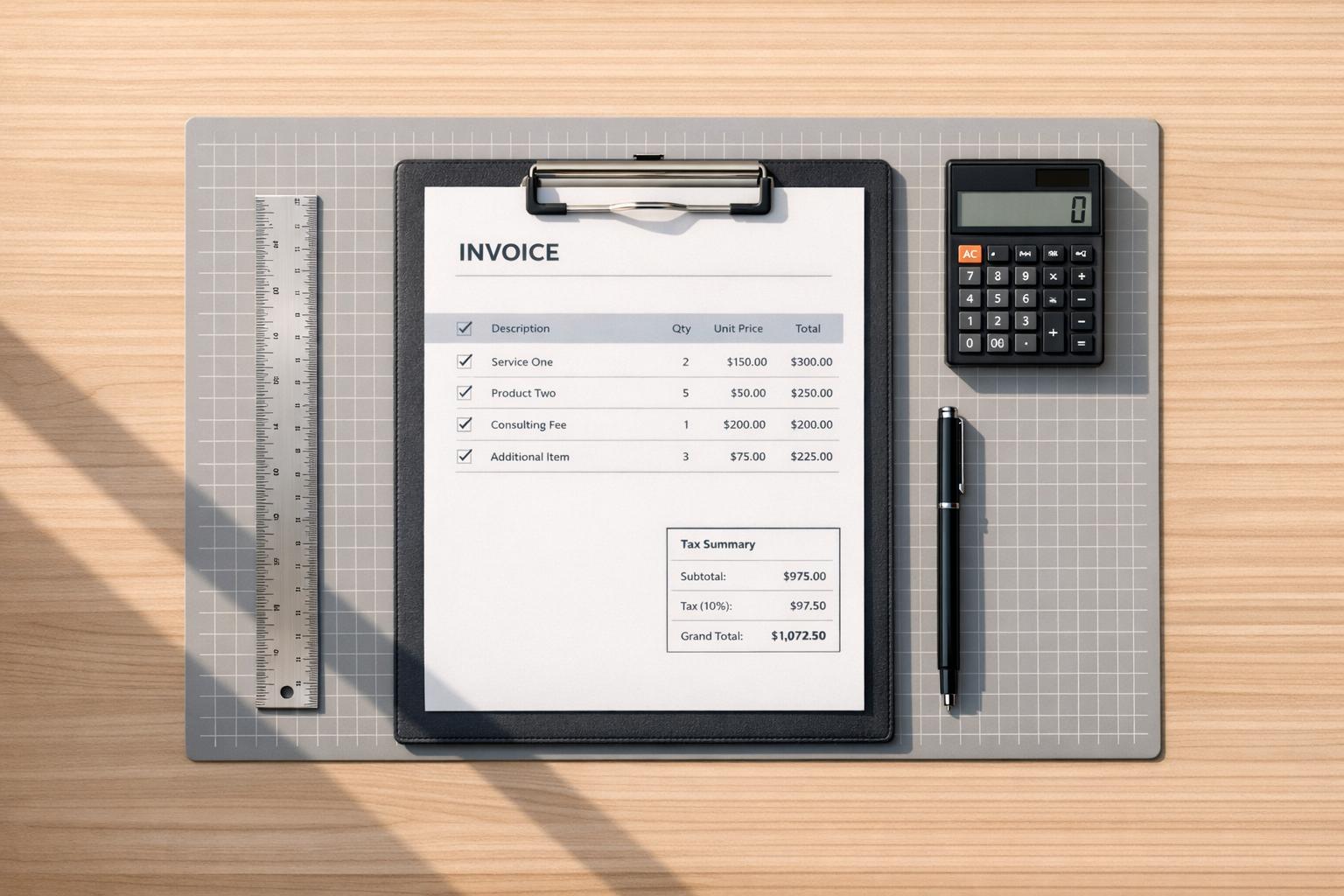
Checklist for Tax-Compliant Invoices
Creating tax-compliant invoices is more than just a formality - it’s a critical step to ensure smooth payments, avoid IRS penalties, and maintain a reliable audit trail. Missing key details could lead to payment delays, audits, or even personal liability for uncollected sales tax. Here's a quick breakdown of what every invoice should include:
- Business Details: Include your legal business name, address, and Tax Identification Number (EIN) for professionalism and accuracy.
- Client Information: Use the client’s full legal name, address, and EIN to support their tax deductions and ensure compliance.
- Invoice Identification: Assign unique, sequential invoice numbers and include both the invoice date and payment due date.
- Itemized Details: Clearly describe services or products, include quantities, rates, and totals, and separate taxable and non-taxable items.
- Tax Breakdown: Specify sales tax rates and amounts to meet IRS and state requirements.
- Payment Instructions: Provide clear payment methods and banking details to avoid delays.
- Record Retention: Keep invoices and supporting documents for at least 7 years to comply with IRS standards.
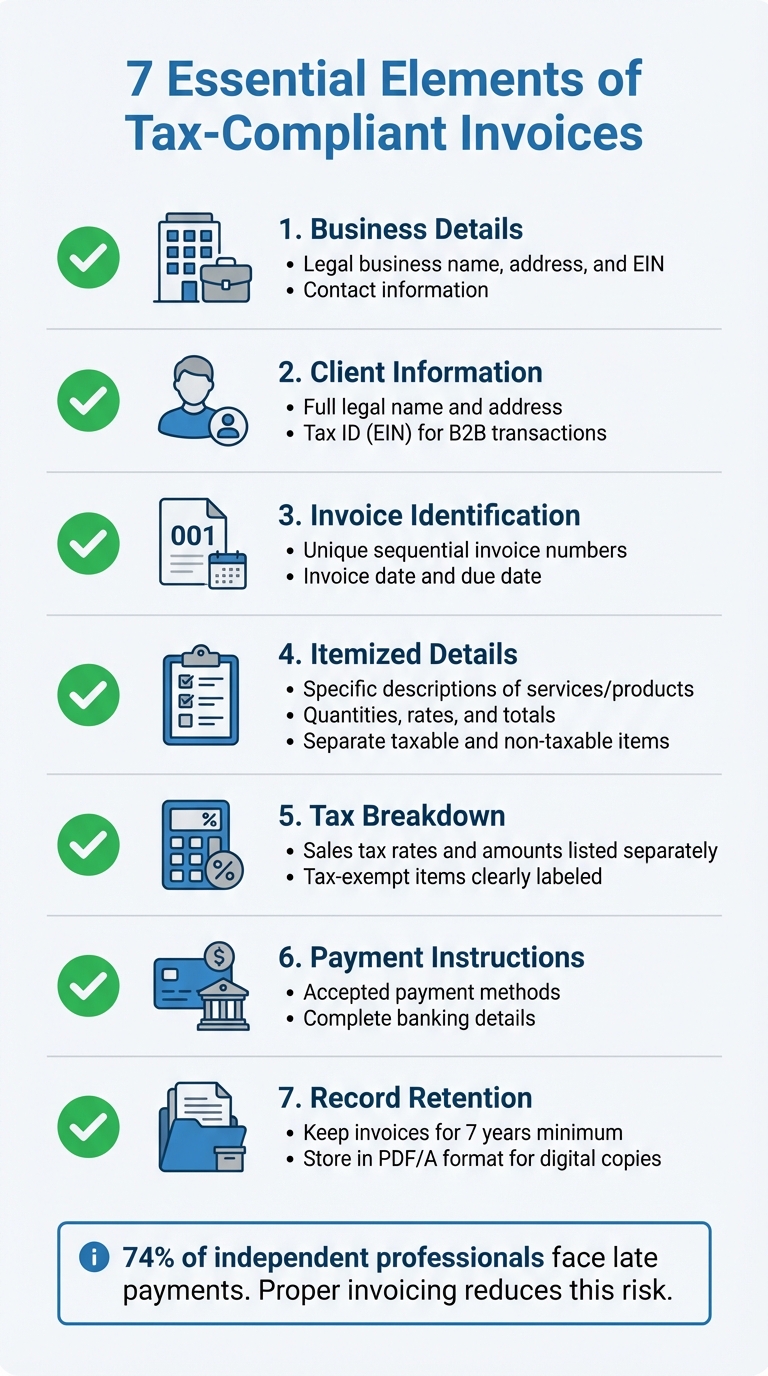
7 Essential Elements of Tax-Compliant Invoices
What should you include on a basic invoice? Here's 6 things you should include🧾
sbb-itb-66f4c95
Business and Seller Information
Every tax-compliant invoice needs to include complete business details. While the IRS doesn’t enforce a specific federal invoice template, your invoice must clearly show who sold what to whom. Be sure to use your full legal business name - not a nickname. If you’re an LLC or Corporation, include the appropriate suffix, like "LLC" or "Inc.". If you’re a sole proprietor, your invoices will typically reflect your legal name, whereas registered entities should use their official business name.
Always include your tax filing address to avoid any inconsistencies. Add a reliable phone number and email address, so clients can easily contact you with any billing questions. Let’s break down the essential business and seller details further.
Legal Business Name and Contact Information
Your business name, address, and contact details should match across all invoices, bank accounts, and tax documents. If you operate under a "Doing Business As" (DBA) name, ensure it’s registered and consistently used across your financial records. This consistency helps avoid confusion for your clients' accounts payable teams and reduces the risk of payment delays.
Tax Identification Number (EIN)
While it’s not federally required to include an EIN on invoices, many B2B, government, and enterprise clients prefer it. They often use it to match invoices with vendor records and for 1099 reporting. Listing your EIN simplifies this process and enhances vendor matching. If you don’t have an EIN, provide a W-9 form instead of using your Social Security Number. Using an EIN protects your identity and adds a layer of professionalism.
Optional Branding Elements
Adding optional branding, like a logo, can make your invoices more recognizable and help finance teams quickly identify them. Keep your design simple and easy to read. Just make sure that your branding doesn’t obscure any required tax details or your legal business name.
Client and Buyer Information
After detailing your business information, the next step is to focus on accurate client details. This is crucial for maintaining tax compliance and ensuring smooth payment processing.
Client's Full Legal Name and Address
Always use your client's registered business name instead of a trade name, nickname, or department name. This ensures legal accuracy and allows the client to properly claim the expense as a tax deduction.
Make sure to include the complete registered address. This is especially important in destination-based states, where sales tax rates depend on the client's location. During onboarding, confirm whether the billing address is different from the shipping address - the billing address is required for tax purposes. Additionally, request the email address for the accounts payable department to make sure your invoice is sent to the correct contact for payment processing.
Once you've verified these details, the next step is to confirm the client's tax identification numbers and formalize the agreement to ensure compliance and simplify transactions.
Tax Identification Numbers for B2B Transactions
For U.S.-based businesses and government clients, including the client's Tax Identification Number (EIN) is essential. This helps with vendor matching during their accounts payable process and supports their year-end reporting requirements.
To streamline this process, collect a Form W-9 from new clients during onboarding. This ensures that the client's Taxpayer Identification Number aligns with IRS records, providing a clear audit trail for both parties.
Invoice Identification and Dates
Once you've confirmed your client's details, the next step is setting up a system to track your invoices effectively. This means assigning unique identifiers and establishing clear dates to meet IRS requirements and streamline your record-keeping. These elements turn your invoices into more than just paperwork - they become essential tools for tax compliance.
Unique Invoice Numbers
Give every invoice a unique, sequential number (e.g., INV-0001) and clearly mark any voided invoices as "VOID" to maintain a complete audit trail. A structured numbering system (like INV-001, INV-002, INV-003) ensures your records are organized and free of gaps, which could otherwise raise red flags during audits by suggesting missing or deleted invoices.
To keep things consistent, use a combination of alphabetic prefixes and leading zeros (e.g., INV-0001). You can also add context to your numbering by including the year or month (e.g., 2026-001) or client-specific codes (e.g., ACME-001) if you manage a high volume of accounts.
"Tax authorities such as the IRS expect you to keep invoice records for at least seven years." - Invoxa
Want to appear more established to new clients? Start your numbering at a higher figure, like 1001, instead of beginning with 001. Using invoicing software with auto-increment features can further reduce errors from manual entry and ensure smooth tracking.
Invoice Date and Due Date
The invoice date is critical - it defines the accounting period for the transaction and starts the clock on payment terms. While the U.S. doesn't mandate a specific federal invoice format, the IRS expects clear documentation of transaction dates. Including both the invoice date and an exact due date (e.g., Due: May 15, 2026) is highly recommended. This not only creates a solid audit trail but also sets clear expectations for payment.
Payment Terms
Spelling out payment terms ensures smoother cash flow and helps enforce late fees. Common terms in the U.S. include:
- "Due on Receipt" (payment required immediately)
- "Net 15" (payment due within 15 days)
- "Net 30" (payment due within 30 days)
Avoid vague phrasing like "Due in 30 days" and instead specify an exact due date (e.g., "Due: May 15, 2026") to avoid confusion and encourage prompt payments. For faster cash flow, you might consider shorter terms like Net 7 or Net 14 instead of Net 30.
Additionally, state any late payment fees explicitly, such as: "A 5% late fee applies after May 15, 2026." This not only motivates timely payments but also supports your financial records and tax documentation, ensuring smooth business operations.
Itemized Description of Services or Products
When preparing invoices, it's important to clearly list your services or products to ensure smooth tax compliance and avoid payment delays. After setting the invoice date and payment terms, take the time to detail each billed item. Vague descriptions can lead to confusion and payment delays, as clients may need more information to match your invoice to their records. Additionally, the IRS requires clear documentation of services or supplies for proper reporting.
Specific and Accurate Descriptions
Be as precise as possible when describing services or products. Avoid generic terms like "Design work." Instead, provide detailed descriptions such as "Logo design - 3 concept options with 2 rounds of revisions." If your billing is time-based, include the service period. For instance, "Marketing consulting for ad campaign planning (April 1–15, 2026)." These specifics not only reduce the likelihood of disputes but also ensure your invoice aligns with the terms of your contract.
| Vague Description (Avoid) | Specific Description (Recommended) |
|---|---|
| Consulting | 2 hours of strategic planning consultation |
| Materials | 10 packages of 80gsm recycled A4 stationery |
| Development | 5 hours of API integration and database optimization |
| Monthly fee | Software subscription: 3 Pro User Licenses (April 2026) |
Once you've clarified your descriptions, make sure to include accurate quantities and pricing.
Quantity, Rates, and Totals
Clearly outline the quantity, unit price, and total cost for each item on your invoice. For example, instead of simply listing "$500", break it down as "5 hours at $100/hour = $500." This level of transparency makes it easier for clients to verify your calculations and reduces the risk of errors that could lead to voided or reissued invoices. Detailed line items also provide a reliable audit trail, which is critical for IRS reviews.
For larger clients or B2B transactions, include any Purchase Order (PO) number they provide. Many organizations require this reference for payment approval. Additionally, if you're selling both taxable and non-taxable items, clearly label tax-exempt items as "Tax Exempt" to prevent confusion during payment processing.
Financial Summary and Tax Calculations
When it comes to invoicing, clarity is key - for both your clients and tax authorities. Summarizing charges into a clear total ensures everyone understands exactly what’s owed and why.
Subtotal, Taxes, Discounts, and Total
Start by calculating the subtotal from all line items. If discounts apply, subtract them before calculating taxes. This approach ensures the taxable amount is reduced appropriately. For instance, if your subtotal is $1,000 and you offer a 10% discount, the discounted subtotal becomes $900. Taxes are then calculated based on this adjusted amount.
Make the tax details explicit. Instead of simply stating "$74.25 tax", break it down: "Sales Tax (8.25%): $74.25". This level of detail not only clarifies the percentage but also ensures compliance. According to IRS Enrolled Agent Kari Brummond, "If an invoice doesn't list sales tax, it cannot be used as proof that you collected sales tax from a customer". The total amount due combines the discounted subtotal, taxes, and any deposits already paid. Make the final total stand out for easy reference.
If you conduct business across state lines, keep in mind that most U.S. states follow destination-based sourcing. This means sales tax is charged based on the client’s location, not yours. For example, states like Alaska, Delaware, Montana, New Hampshire, and Oregon don’t impose state sales tax, but others, such as Tennessee (9.55%), Louisiana (9.52%), and Arkansas (9.51%), have some of the highest combined rates in the country.
Sales Tax Documentation
After calculating totals, make sure tax exemptions are properly documented. If a transaction is tax-exempt, include a clear note, such as "Tax-exempt customer – certificate on file." Omitting the tax line without explanation can lead to confusion or compliance issues.
For invoices with both taxable and non-taxable items, label each clearly. For example, consulting services are often tax-exempt, while physical materials typically are not. Mark the consulting line as "Tax Exempt" and apply sales tax only to the materials. This level of itemization prevents misunderstandings and ensures your records meet IRS standards.
If you’re invoicing international clients, include the ISO currency code (e.g., USD) and note any applicable exchange rates. This extra detail helps avoid discrepancies when dealing with cross-border transactions.
Payment Instructions and Methods
When your client sees the total amount due, the next logical question is: how do they pay? Simplifying this step can speed up the payment process. For more tips on managing your billing, check out our latest invoicing insights. Clear and straightforward payment instructions reduce delays and make the transition from invoicing to payment seamless.
Accepted Payment Methods
Stick to one or two preferred payment options to keep things simple. For bank transfers (ACH), provide the following details:
- Bank name
- Account holder name (exactly as it appears on your records)
- Routing number
- Account number
- Account type
If you accept credit or debit card payments, include a direct "Pay Now" link for convenience.
For online payment platforms like PayPal, share your PayPal email address or a PayPal.me link. If you accept checks, specify the payee name and provide your complete mailing address. For international clients, ensure you include details like your IBAN, SWIFT/BIC, and the currency you accept (e.g., USD).
These payment methods not only speed up the process but also help you maintain accurate financial records, which is crucial for tax reporting.
Banking Details
Accuracy is critical here. Even a small mistake, like a typo in your routing number, can lead to frustrating delays. To avoid this, create a dedicated "Payment Instructions" section where all banking details are clearly listed. Add a payment memo request, such as: "Please include Invoice #INV-1027 in the ACH memo field," to help you easily match payments to invoices during reconciliation.
To protect against fraud, verify any changes to banking details through a secondary channel, such as a phone call. For repeat clients, you might note "Banking details on file" on future invoices instead of including your full account information each time. This approach adds a layer of security while maintaining efficiency.
U.S. Tax Compliance Requirements
When it comes to U.S. tax compliance, sticking to IRS and state-specific rules is a must. While the IRS doesn’t demand a particular invoice format, your invoices should clearly document all income and deductions. This ensures your records are both transparent and audit-ready.
IRS Invoice Requirements
To meet IRS standards, your invoice should include these key elements:
- Dates: Include both the invoice date and the date when the service was performed or the product was delivered.
- Detailed Descriptions: Avoid vague terms like "services rendered." Instead, provide clear, specific descriptions of the goods or services so anyone reviewing the invoice later can fully understand the transaction.
- Financial Breakdown: Show line-by-line details, including rates, quantities, subtotals, applicable taxes (listed separately), and the total amount due.
- Taxpayer Identification Number (TIN): While not always required on the invoice, you may need to provide your EIN or SSN via Form W-9 for 1099-NEC reporting.
State laws often require sales tax to be listed as a separate line item. Combining tax with the product price could result in the entire amount being treated as taxable. Additionally, tax rates may vary depending on whether the state uses an origin-based (seller’s location) or destination-based (client’s location) approach.
By following these IRS and state-specific guidelines, your invoices will be ready for both clients and audits.
Record Retention Standards
The IRS generally requires you to keep invoices and related tax records for at least 3 years from the date you file your return. However, there are exceptions:
- If you underreport your gross income by more than 25%, the retention period extends to 6 years.
- For deductions involving bad debts or worthless securities, you’ll need to keep records for 7 years.
To simplify, it’s smart to adopt a 7-year retention policy. This covers longer state-specific requirements, like Kentucky’s 6-year rule, and gives you a buffer in case of audit delays.
Here’s a quick look at retention periods across jurisdictions:
| Jurisdiction | Retention Period | Key Consideration |
|---|---|---|
| Federal (IRS) | 3 years | Standard for most business expenses |
| California | 4 years | Installation labor must be itemized |
| New York | 3 years | Shipping must be listed separately for exemption |
| Texas | 4 years | "Tax-included" pricing allowed if explicitly stated |
| Kentucky | 6 years | Among the longest state requirements |
Keep your invoices organized alongside other supporting documents like contracts, delivery proofs, and payment confirmations. Electronic invoices are acceptable as long as they remain readable, easily accessible, and reproducible when needed. This thorough approach not only satisfies IRS requirements but also ensures your financial records stay accurate over the long term.
Documentation and Record-Keeping Standards
Keeping tax-compliant invoices on file is crucial for being prepared in case of an audit. The IRS allows digital invoices under Revenue Procedure 97-22, but your system must meet certain conditions. These include creating an accurate digital reproduction, indexing for quick access, maintaining legibility, conducting quality checks, implementing security measures, and adhering to proper retention timelines.
Storage of Invoices in Original Format
Digital copies must replicate every detail of the original invoice, including text, graphics, logos, and formatting. The PDF/A format is ideal for this purpose. It’s specifically designed for long-term archiving, ensuring that files remain readable even as technology changes. Unlike standard PDFs, PDF/A preserves the original formatting over time.
To streamline audits, index invoices using key details like vendor name, date, invoice number, and total amount. If you’re digitizing paper invoices, wait at least 30 days before disposing of the originals. This allows time to confirm that the digital versions are accurate and error-free. To further ensure quality, randomly check 5% to 10% of scanned invoices for legibility.
"The original paper invoice can be destroyed only after you have verified the digital copy satisfies all six Revenue Procedure 97-22 requirements." - David Harding, Founder, Invoice Data Extraction
While securing digital invoices is essential, it’s equally important to verify and retain supporting documents to complete your audit trail.
Supporting Documentation
Besides invoices, you’ll need to keep supporting documents like itemized receipts and contracts. The IRS requires itemized receipts to justify business expenses because bank or credit card statements alone don’t provide enough detail. For instance, a bank statement showing a $150 charge at an office supply store doesn’t explain what was purchased or if it was for business use. An itemized receipt listing "printer paper, 10 reams" provides the necessary proof for deductions.
Other essential documents include contracts, proposals, statements of work, timesheets, delivery confirmations, and email correspondence confirming project acceptance. For reimbursable expenses, keep itemized receipts in a separate file. Categories like travel and meals often face greater scrutiny, so maintain logs that detail the business purpose and list attendees. Additionally, retain proof of payment, such as canceled checks, ACH confirmations, PayPal or Stripe records, and 1099-NEC forms, to reconcile reported income.
When destroying paper records after digitizing them, record the date, details, and authorization to demonstrate a consistent compliance process. For sensitive documents like bank statements or canceled checks, always shred them instead of recycling to safeguard your account details.
Conclusion
Tax-compliant invoicing is more than just a formality - it’s a safeguard for your business. It ensures timely payments, reduces the risk of disputes, and helps you avoid IRS penalties by creating a legally valid document. Including essential details like sequential numbering and a precise tax breakdown not only protects your business but also establishes a clear financial trail for accurate income reporting and easier tax filing.
"A compliant tax invoice is not just a nice to have. It is the document that keeps your customer, your accountant and your tax authority on the same page." - Invozee
Late payments are a common challenge, with nearly 74% of independent professionals facing this issue. Proper invoicing can help minimize this risk significantly. Many B2B clients require compliant invoices to process payments and claim their business expenses, making it crucial to standardize your invoicing process. This practice simplifies income tracking, reduces tax filing errors, and improves the accuracy of quarterly tax estimates.
Beyond compliance, a streamlined invoicing process can make managing cash flow much easier. Tools like Paid on Time offer solutions such as secure upfront payments, legally binding agreements, and one-click charges. These features help maintain accurate records, reduce disputes, and provide more predictable cash flow.
Start implementing a tax-compliant invoicing system today - your accountant will thank you when tax season rolls around.
FAQs
Do I need to include my EIN on every invoice?
In the United States, it's typically not mandatory to include your EIN (Employer Identification Number) on every invoice. Whether or not you need to include it depends on the type of tax involved and the specific situation. To stay compliant, always review the relevant tax guidelines for your circumstances.
Which address determines the sales tax rate?
The sales tax rate depends on the address associated with the transaction. Depending on the state's rules, it could be calculated based on the billing address or the shipping address. To stay compliant, always review the specific regulations for the state in question.
What other records should I keep with invoices for an audit?
Keeping thorough records is just as important as issuing invoices. Make sure to save all documents that back up your reported income and expenses. This includes receipts, bank statements, canceled checks, and detailed accounting records. Staying organized with these materials can be a lifesaver if the IRS ever conducts an audit. Well-maintained records can help prove compliance, minimize the chance of deductions being rejected, and avoid potential penalties.