5 Ways to Avoid Payment Disputes With Clients
5 Ways to Avoid Payment Disputes With Clients
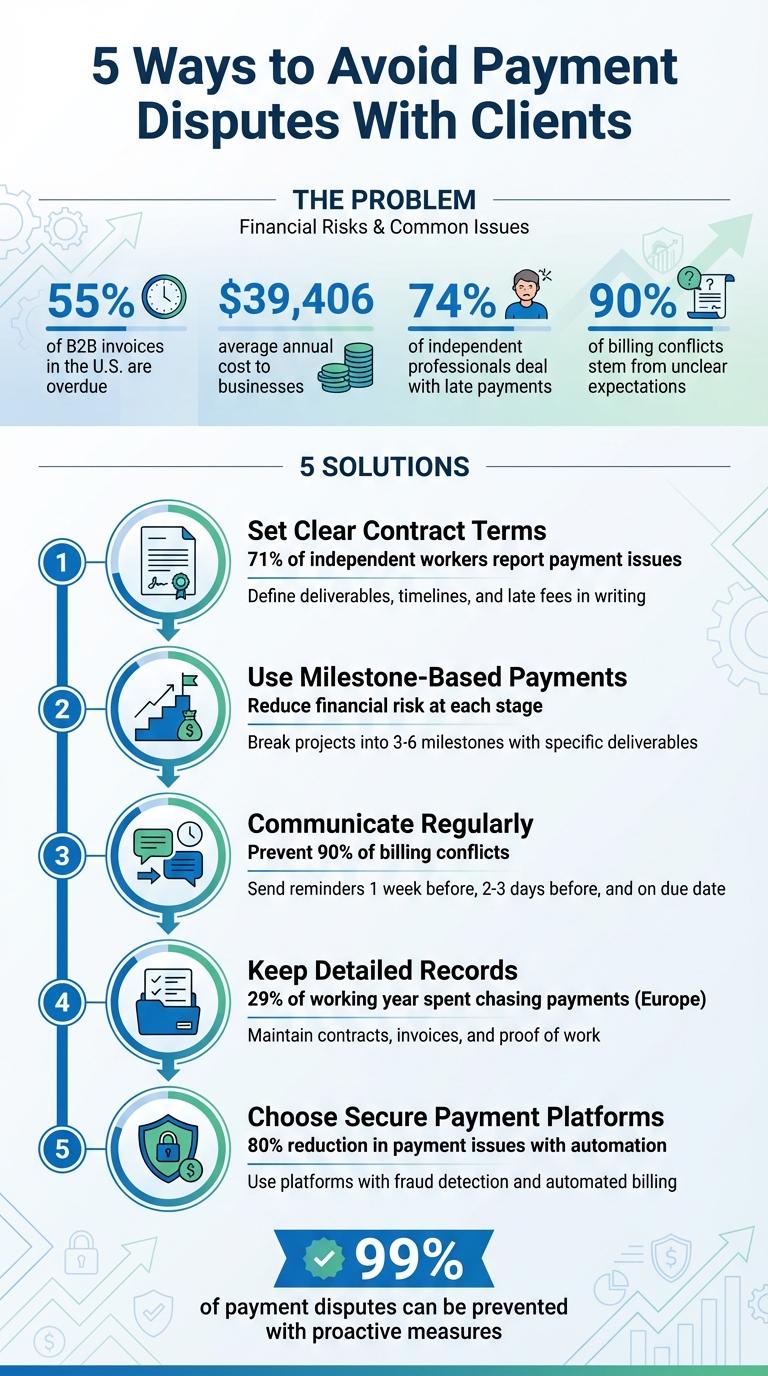
Payment disputes can disrupt your cash flow and waste valuable time. Over 55% of B2B invoices in the U.S. are overdue, costing businesses an average of $39,406 annually. The good news? Most disputes stem from preventable issues like unclear contracts, scope creep, or miscommunication. Here’s how you can avoid them:
- Set Clear Contract Terms: Define deliverables, payment timelines, and late fees in writing. Use plain language and require upfront deposits.
- Use Milestone-Based Payments: Break projects into stages with payments tied to specific deliverables. This reduces risks and ensures steady cash flow.
- Communicate Regularly: Keep clients updated to avoid misunderstandings and ensure alignment on expectations.
- Keep Detailed Records: Maintain contracts, invoices, and proof of work to quickly resolve disputes if they arise.
- Choose Secure Payment Platforms: Use tools that automate payments, track approvals, and offer fraud protection.
Payment Dispute Statistics and Prevention Strategies for Freelancers
How can business owners avoid payment disputes with clients?
sbb-itb-66f4c95
1. Set Clear Contract Terms and Payment Conditions
A written contract is your best defense against payment disputes. With 71% of independent workers reporting issues collecting payments, it's clear that many problems arise from unclear expectations. By detailing everything in writing, you can eliminate the ambiguity behind 90% of billing conflicts.
Clarity and Transparency in Agreements
Your contract should answer the big questions: What work are you delivering? When is payment due? What happens if things go off track? Be specific about deliverables, scope boundaries, and payment triggers - whether payment is due upon project completion or after client approval. This approach helps avoid scope creep and delays.
For example, clarify payment triggers like "completion" versus "sign-off" to prevent delays caused by extended review processes. Replace vague terms like "ASAP" or "due upon receipt" with exact deadlines, such as "Payment due by March 15, 2026".
"Most payment disputes start with unclear expectations, not bad intent."
- Greg Mitchell, Legal Consultant, AI Lawyer
Effectiveness in Reducing Payment Delays or Disputes
Adding late fees - such as 1.5% monthly interest or flat penalties - can discourage overdue payments. Some contracts also include a clause to pause work if invoices go unpaid. In New York City, the "Freelance Isn't Free" law even allows freelancers to claim double damages plus attorney fees if they win a non-payment case in court.
Consider including a dispute window, such as allowing clients 7 days to raise billing concerns. After that period, the invoice is automatically considered accepted. These proactive measures not only reduce delays but also make your agreements enforceable and straightforward.
Ease of Implementation for Freelancers and Small Businesses
You don't need a law degree to create an effective contract. Use plain, easy-to-understand language - write "payment within 30 days" instead of "Net 30" to keep things simple. Also, requiring an upfront deposit (typically 25–50% of the total fee) ensures commitment before you begin working.
| Essential Contract Element | Purpose | Example |
|---|---|---|
| Scope of Work | Clearly defines project boundaries to prevent scope creep | "Three logo concepts with two rounds of revisions" |
| Payment Schedule | Establishes clear deadlines and amounts | "50% deposit ($2,500) due by March 1, 2026; final payment due within 15 days of delivery" |
| Late Fees | Encourages timely payments | "1.5% monthly interest on overdue balances" |
| Dispute Resolution | Outlines how conflicts will be handled | "Disputes resolved through mediation in California" |
Support for Secure and Verifiable Transactions
In addition to clear terms, specifying secure payment methods helps protect your cash flow. Your contract should list acceptable methods like ACH transfers, credit cards, or wire transfers, and include your tax ID and contact details. Platforms that securely store client payment information - like Paid on Time - can simplify the process by enabling automatic charges upon milestone completion.
To further protect your agreement, include an integration clause (or "merger clause") stating that the written contract represents the entire agreement. This prevents disputes about prior verbal arrangements. Courts typically enforce clear contract language as written, so if your contract says "Payment is due within 30 days", that's exactly what will be upheld.
2. Use Milestone-Based Payment Structures
Breaking projects into smaller, well-defined stages can make a world of difference when it comes to securing timely payments. Milestone-based billing ensures you get paid at specific checkpoints - like delivering a first draft, wrapping up the design phase, or launching a beta version - rather than waiting until the project’s completion. This approach significantly reduces your financial risk. If a client misses a payment at an early milestone, you can halt work immediately instead of completing the entire project without compensation.
Clarity and Transparency in Agreements
For milestone billing to work smoothly, each stage needs precise, measurable deliverables - no vague terms like "halfway done." Instead, use clear benchmarks such as "submission of detailed logo concepts" or "approval of finalized wireframes". A typical payment breakdown might look like this: 20% upon signing the contract, 30% at the project’s midpoint, and 50% upon final delivery. For longer projects (over 60 days), aim for three to six milestones. Too few stages can leave gaps in payment checkpoints, while too many can create unnecessary administrative work. This clarity not only sets expectations but also helps you stay on top of payment tracking.
"Milestone payments guarantee compensation at different project stages, reducing the risk of non-payment after delivering the final product."
Effectiveness in Reducing Payment Delays or Disputes
Milestone billing can spot potential payment issues early on. Back in 2016, around 27 million freelancers reported difficulties getting paid for their work. By tying payments to specific deliverables, you can quickly determine whether a client is reliable. Including a "work stop" clause in your contract - where work halts if a payment is overdue - encourages clients to prioritize your invoices. Additionally, this structure helps you avoid scope creep. If a client requests work outside the agreed milestones, it’s an opportunity to renegotiate the contract or charge extra fees. For disputes over milestone payments, secure payment platforms often include dispute resolution tools to help you resolve issues efficiently.
Ease of Implementation for Freelancers and Small Businesses
You don’t need complex tools to start using milestone billing. Decide whether task-based milestones (triggered by specific deliverables like a prototype) or phase-based milestones (linked to time periods like monthly or quarterly) work best for your project. Keep payment terms short - ideally "due upon receipt" or within 7 to 10 days - so you’re paid promptly for completed work. If a client delays a milestone, document it and adjust future deadlines as needed.
Support for Secure and Verifiable Transactions
Secure payment platforms make milestone billing easier by collecting payment details upfront and automating charges when milestones are completed. This reduces the hassle of invoicing and chasing payments. These platforms also create legally binding agreements that clearly outline acceptance criteria for each milestone - defining exactly what a deliverable must meet to trigger payment. To avoid disputes, include milestone reports or signed approval documents with your invoices. Automation can also save time; in Europe, for instance, businesses reportedly spend 29% of their working year chasing overdue payments. Using automated systems ensures you spend less time following up and more time focusing on your work.
3. Communicate Regularly and Check In With Clients
Staying in regular contact with clients is one of the simplest ways to avoid payment disputes. In fact, 90% of billing conflicts stem from unclear project scopes. Without frequent updates, clients might start questioning charges or even lose trust. Pairing proactive communication with clear contracts and milestone-based billing can go a long way in keeping your cash flow steady.
Effectiveness in Reducing Payment Delays or Disputes
Consistent communication helps you spot and address potential issues before they escalate. For example, if a client requests changes outside the agreed scope, a quick check-in can clarify how those changes will affect both the timeline and budget, reducing the chances of disputes. Another common issue? The person approving your work (like a marketing manager) may not be the one managing payments (like a CFO). Keeping all key stakeholders informed ensures everyone is on the same page.
"Be proactive: over-communicate, automate where possible, and don't be afraid to enforce boundaries - it's about respect, not just cash flow."
- Justin Belmont, Founder, Prose
Ease of Implementation for Freelancers and Small Businesses
Good communication doesn’t require fancy tools or expensive systems. For instance, you can start by sending a friendly reminder about an upcoming invoice a week before it’s due, giving your client time to prepare their funds. Follow this up with another reminder 2–3 days before the due date, and then a final note on the due date itself. If payment is still pending, reach out within 3 to 5 business days to confirm receipt. Often, a quick phone call can resolve payment issues much faster than an email back-and-forth.
Support for Secure and Verifiable Transactions
Keeping a record of your communications is essential for protecting both yourself and your client. Use tools like email or client portals to log all interactions, from approvals to status updates, with timestamps. This documentation can be a lifesaver if a dispute arises. Payment platforms that offer automated updates also help reduce confusion around billing. Regular progress reports, meanwhile, keep clients informed and minimize the risk of disputes over invoices.
| Follow-Up Stage | When | Action |
|---|---|---|
| Pre-Invoice | 1 week before due date | Send a friendly reminder to help the client prepare funds. |
| Due Date | Day of | Send a short, professional note with a payment link. |
| First Overdue | 3–7 days late | Politely ask: "Can you let me know when to expect payment?". |
| Second Overdue | 14 days late | Send a firmer email or make a call, referencing the contract if needed. |
| Final Warning | 30 days late | Clearly outline consequences, such as late fees or paused work. |
4. Keep Detailed Records and Documentation
Keeping thorough records is your safety net during payment disputes. Did you know that 74% of independent professionals deal with late payments? Without a clear paper trail, these situations can spiral into bigger problems. By assembling a well-organized billing packet - including your contract, itemized invoices, proof of delivery, and documentation of scope changes - you create a solid link between the work you’ve completed and the payment you’re owed.
Effectiveness in Reducing Payment Delays or Disputes
Good documentation can stop disputes before they even begin. If a client questions a charge, you can quickly produce time logs, delivery confirmations, or emails approving additional work. This level of preparedness makes a huge difference - European businesses reportedly spend 29% of their working year chasing overdue payments.
"Written contracts are generally preferred because they provide a tangible record of the terms agreed upon by the parties." - Aaron Hall, Attorney
When disputes reach a legal stage, having detailed records can be the deciding factor in your favor.
Ease of Implementation for Freelancers and Small Businesses
Staying organized doesn’t have to be complicated. Start with simple steps like using sequential invoice numbers (e.g., INV-001, INV-002) to keep things tidy and make tax preparation easier. If a client requests changes during a project, immediately document how this affects your budget and timeline, and get written approval before proceeding. Including supporting materials - like timesheets or milestone breakdowns - with your invoices helps clients understand exactly what they’re paying for. This level of transparency not only avoids surprises but also builds trust.
Support for Secure and Verifiable Transactions
Thorough documentation also ensures your transactions are secure and verifiable. Payment authorizations, for instance, confirm that a client approved a specific charge on a given date. Similarly, milestone reports show that agreed-upon project phases were completed before billing. If a client later disputes a charge as "unauthorized", these records act as your evidence.
"Most payment disputes start with unclear expectations, not bad intent." - Greg Mitchell, Legal Consultant, AI Lawyer
5. Choose Secure Payment Methods and Platforms
After establishing clear contracts and maintaining thorough documentation, the next step in protecting your payments is selecting secure payment methods. The payment platform you choose can make a big difference when it comes to resolving disputes. With late payments being a common issue, using a platform that includes built-in protections is a smart move. These systems do more than process payments - they provide a verifiable record of transactions, confirming work delivery and client approvals.
Effectiveness in Reducing Payment Delays or Disputes
Modern payment platforms incorporate advanced tools like AI-powered fraud detection to flag suspicious activity. For instance, Stripe Radar evaluates the risk of every payment and can initiate "pre-dispute" inquiries to address issues before they escalate into formal chargebacks. Features like 3D Secure add an extra layer of cardholder verification, shifting fraud liability from your business to the card issuer. This is especially important when considering that disputed invoices cost U.S. businesses an average of $39,406 annually in collection-related expenses. These tools work hand-in-hand with your contracts and documentation to ensure every transaction is secure.
"We reduced payment issues by 80% by switching to milestone-based payments - clients pay before each phase begins, not after." - Harmanjit Singh, Origin Web Studios
Support for Secure and Verifiable Transactions
Choose platforms that offer transparent statement descriptors, which are the 5 to 22 characters that show up on your client's bank statement. Aligning this descriptor with your business name or website domain helps avoid disputes over "unrecognized transactions." Additionally, platforms that log client approvals with timestamps and IP addresses provide an extra layer of security. For larger projects, consider using an "auth and capture" system, which holds funds for up to seven days. This gives you time to verify the payment before it’s finalized. When paired with milestone-based billing and clear contracts, these tools create a strong defense against disputes.
Ease of Implementation for Freelancers and Small Businesses
Adopting secure payment systems is straightforward, even for smaller operations. Payment links, for example, allow you to accept funds via email or text. Automated invoicing and payment links not only make transactions smoother but also cut down on administrative work. Platforms like Paid on Time simplify the process further by collecting payment methods upfront through legally binding agreements. Once the work is completed, one-click charges replace manual invoicing, reducing disputes and saving time. Additionally, robust fraud prevention measures can help you avoid costs like the $15 fees often associated with disputes.
"Be proactive: over-communicate, automate where possible, and don't be afraid to enforce boundaries - it's about respect, not just cash flow." - Justin Belmont, Founder, Prose
Conclusion
Payment disputes often arise from unclear expectations, poor communication, or a lack of safeguards. The strategies outlined here work together to create a system that protects both you and your clients. Clear contracts establish enforceable terms before work begins, while milestone-based payments ensure steady cash flow throughout the project. Regular communication helps prevent misunderstandings from escalating, and detailed documentation serves as solid evidence if conflicts arise. Finally, secure payment platforms simplify the payment process. Together, these methods create a streamlined approach to maintaining your cash flow.
By combining these strategies, you're doing more than just avoiding disputes - you’re fostering trust. Contracts safeguard your interests, while documentation provides the proof you might need. Open communication ensures clients feel informed and involved, and milestone payments demonstrate commitment on both sides. The result? A professional relationship built on respect and clarity.
Data supports the effectiveness of these practices. Proactive measures like strong contracts, upfront deposits, and automated systems can prevent up to 99% of payment disputes. Beyond saving money, these strategies save you time, reduce stress, and eliminate the hassle of chasing unpaid invoices.
"Contracts are not just legal formalities - they are your insurance policy in business." - Malik Tayyab Shahzad, Advocate and Contract Specialist
Implementing these methods doesn’t require a complete overhaul. Start small - perhaps by requiring upfront deposits or setting up automated payment reminders - and gradually adopt the rest. Tools like Paid on Time make collections easier by securely storing payment details and enabling one-click charges upon project completion. This reduces manual invoicing and cuts down on delays. The goal isn’t perfection - it’s creating a business model where getting paid is predictable, professional, and free of disputes.
FAQs
What should I do if a client disputes an invoice after approving the work?
To address a dispute effectively, begin by carefully reviewing the reasons behind it and collecting relevant documents. These might include the contract, scope of work, and any communication records. Once you have a clear understanding, have a professional conversation with the client to clarify any misunderstandings and attempt to resolve the issue amicably.
If the matter remains unresolved, you may need to explore formal options such as mediation or even legal action. Throughout this process, make sure to maintain detailed records of all communications and actions. These will be essential in supporting your case if the situation escalates.
How many milestones should I use for a 2–3 month project?
For a project lasting 2–3 months, it's generally a good idea to set 2 to 3 milestones. This approach helps break the project into manageable phases, making it easier to track progress and ensure timely payments. It also keeps both parties in sync, reducing the chances of miscommunication or delays.
What records should I keep to win a payment dispute quickly?
To handle a payment dispute efficiently, it's crucial to maintain thorough records that back up your claim. These should include items like a signed contract, email exchanges detailing the agreed terms, signed statements of work, and any other correspondence or documents related to the project and payment. With this evidence in hand, you can clearly demonstrate that the work was completed as agreed and that the client was fully aware of the payment terms. This approach makes resolving disputes much smoother and quicker.